

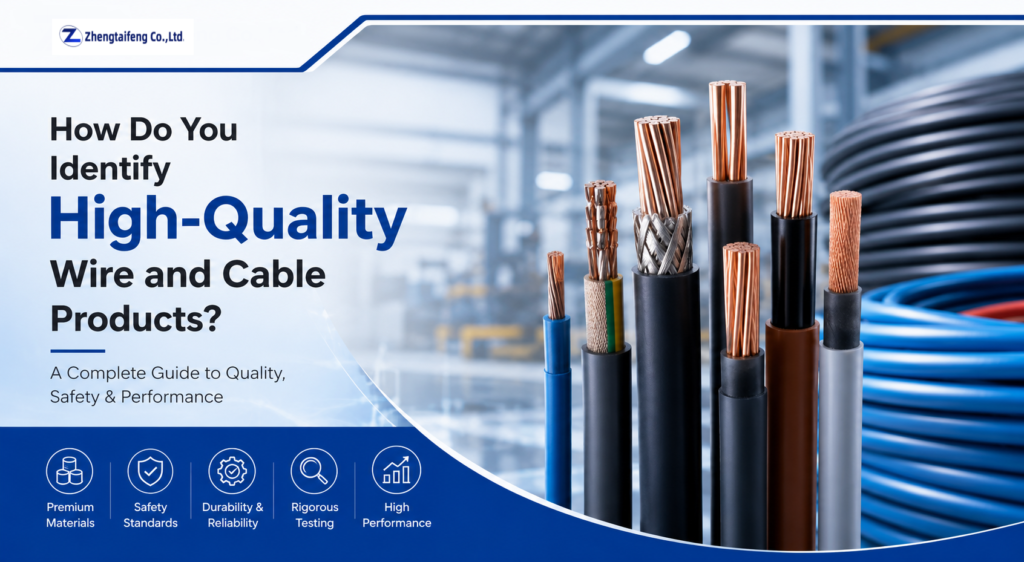
Choosing the right wire and cable products is an important decision for electrical contractors, manufacturers, construction companies, distributors, and industrial businesses. The quality of electrical cables directly affects safety, system performance, energy efficiency, and long-term operating costs. A product that looks reliable from the outside does not always meet the technical requirements needed for a particular application.
With growing demand for renewable energy, electric vehicles, smart infrastructure, and advanced electrical systems, buyers are paying closer attention to cable materials, insulation technologies, manufacturing standards, and product certifications. Low-smoke, halogen-free materials, improved insulation, and energy-efficient electrical infrastructure are among the important considerations shaping modern cable selection.
But how do you distinguish a genuinely reliable product from one that only looks good on paper?
Identifying high-quality wire and cable products requires more than comparing prices or checking product appearance. Buyers need to evaluate conductor materials, insulation quality, electrical performance, manufacturing consistency, safety certifications, and suitability for their intended applications.
In this guide, Zhengtaifeng Co., Ltd explains the essential factors to consider when evaluating wire and cable products so businesses can make informed purchasing decisions and select solutions that deliver reliable performance over time.
1. Check the Quality of Conductor Materials
The conductor is one of the most important components of any electrical wire or cable. It carries electrical current, so its material quality directly influences conductivity, resistance, flexibility, and overall performance.
Copper and aluminium are the two commonly used conductor materials.
- Copper conductors: Copper offers excellent electrical conductivity, good mechanical strength, and reliable performance across various electrical applications. It is commonly used in residential wiring, industrial equipment, power distribution, and electrical installations.
- Aluminium conductors: Aluminium is lighter than copper and often provides a cost-effective option for power transmission and distribution. However, its electrical and mechanical properties differ from copper, so the cable design must match the intended application.
When evaluating conductor quality, buyers should consider:
- Material purity and consistency.
- Electrical conductivity.
- Conductor cross-sectional area.
- Resistance levels.
- Strand construction and flexibility.
- Compliance with applicable product specifications.
A high-quality cable should have a conductor designed to meet its specified electrical requirements. Undersized conductors or inconsistent material quality can increase resistance, generate excess heat, and affect electrical safety.
2. Evaluate Insulation and Sheathing Quality
Conductor quality alone does not determine whether a cable is reliable. Insulation and outer sheathing also play an important role in protecting the electrical conductor from environmental and mechanical damage.
Insulation prevents unwanted electrical contact, while the outer sheath provides additional protection against moisture, abrasion, chemicals, heat, and other external conditions.
Different cable applications require different insulation materials.
Common materials include:
- PVC: Widely used because of its versatility, electrical insulation properties, and cost-effectiveness.
- XLPE: Offers improved thermal performance and electrical properties, making it suitable for various power cable applications.
- PE: Provides useful electrical insulation and moisture resistance in selected cable applications.
- LSZH: Low Smoke Zero Halogen materials are designed to reduce smoke and halogen acid gas emissions during fire conditions.
The latest focus on fire safety and sustainable infrastructure has increased interest in LSZH cable solutions, particularly in public buildings, transportation facilities, commercial properties, and enclosed environments.
Before purchasing, check the insulation thickness, material specifications, temperature rating, and suitability for the installation environment.
3. Verify Relevant Quality Certifications and Testing Standards
Certifications and testing documentation help buyers understand whether a wire or cable product has been evaluated against recognised technical requirements.
However, not every certification applies to every cable. Requirements depend on the product category, destination market, electrical application, and relevant regulations.
Look for applicable standards and certifications, such as:
- IEC standards for electrical and cable products.
- UL certification for applicable products sold in relevant markets.
- CE marking where applicable under European Union legislation.
- RoHS compliance for relevant restrictions on hazardous substances.
- ISO 9001 certification for quality management systems.
It is important to understand the difference between product certification and company-level certification. For example, ISO 9001 relates to an organisation’s quality management system. It does not automatically certify every product manufactured by that organisation.
Ask suppliers for relevant test reports, certification details, product specifications, and supporting documentation.
A reliable manufacturer should be able to explain which standards apply to its products and provide appropriate evidence.
4. Understand the Latest Wire and Cable Industry Trends
The wire and cable industry is evolving as businesses invest in renewable energy, electric mobility, smart infrastructure, and advanced manufacturing facilities.
According to the International Wire & Machinery Association (IWMA), electrification, renewable energy, digital infrastructure, and grid investment are important drivers of global cable demand.
Some important developments buyers should consider include:
Low Smoke Zero Halogen (LSZH) technology
LSZH cables are attracting attention because they are designed to produce lower smoke and avoid halogen acid gas emissions during combustion. They are particularly relevant to applications where fire evacuation and indoor air quality are important considerations.
Advanced XLPE insulation
Cross-linked polyethylene insulation is widely used in power cables because of its thermal and electrical properties. It is relevant to applications requiring dependable performance under demanding operating conditions.
Renewable energy cable solutions
Solar and wind energy installations require cables designed for their operating environments. UV exposure, temperature variation, moisture, and mechanical stress are important selection factors.
Electric vehicle and charging infrastructure
EV charging networks are increasing demand for specialised electrical connections and cables. Flexibility, thermal performance, durability, and electrical ratings are important considerations.
Smart manufacturing and digital quality control
Manufacturers are increasingly exploring automated inspection, production monitoring, and digital traceability. These technologies help improve production consistency and identify potential defects earlier.
For buyers, understanding these developments helps when comparing suppliers and selecting products suited to modern industrial requirements. However, a newer technology does not automatically make a cable suitable for every application. Always check its technical specifications and intended use.
5. Examine the Cable’s Electrical Performance
Electrical performance is a critical factor when selecting high-quality wire and cable products. Even a cable with good external finishing may not deliver reliable results if its electrical characteristics do not meet the application requirements.
Consider these technical specifications:
- Voltage rating: Confirm that the cable supports the operating voltage of the electrical system.
- Current-carrying capacity: Check whether the cable handles the expected electrical load without exceeding its permitted temperature.
- Electrical resistance: Lower resistance, within the appropriate design and material specifications, helps minimise unnecessary power losses.
- Temperature rating: Ensure the insulation and cable construction support the expected operating temperature.
- Dielectric strength: Check the insulation’s ability to withstand electrical stress.
- Short-circuit performance: For relevant power applications, verify the cable’s ability to withstand specified short-circuit conditions.
Do not select a cable based on conductor size alone. Installation conditions, ambient temperature, grouping, cable length, voltage drop, and load requirements also influence the correct specification.
6. Inspect Physical Construction and Manufacturing Consistency
Physical inspection offers useful clues about manufacturing quality. Although appearance alone cannot confirm electrical performance, visible defects should never be ignored.
Before approving a product or placing a bulk order, examine:
- Consistency of the outer insulation.
- Smooth and uniform cable surfaces.
- Proper conductor arrangement.
- Absence of cuts, cracks, and exposed conductor sections.
- Consistent cable diameter and insulation thickness.
- Clear and accurate product markings.
- Proper packaging and protection during transportation.
For industrial buyers, manufacturing consistency is particularly important when ordering large quantities. Variations between production batches can create installation difficulties, increase rejection rates, and affect equipment performance.
Ask the supplier whether it follows documented inspection procedures and performs regular production quality checks.
7. Consider the Application and Operating Environment
A high-quality cable is not necessarily suitable for every installation. The correct choice depends on where and how the product will be used.
For example, a cable designed for indoor electrical wiring might not provide the protection required for an outdoor industrial installation.
Consider these application requirements:
| Application | Important selection factors |
| Residential buildings | Electrical safety, insulation, and fire performance |
| Industrial facilities | Temperature resistance, durability, and electrical load |
| Solar installations | UV resistance, weather protection, and DC ratings |
| EV charging | Flexibility, thermal performance, and charging requirements |
| Data centres | Fire performance, cable management, and transmission requirements |
| Outdoor installations | Moisture resistance, UV protection, and mechanical strength |
Environmental conditions also deserve attention. Exposure to chemicals, oils, sunlight, water, vibration, and repeated bending can affect cable service life.
Share the actual operating conditions with your supplier before finalising a product specification.
8. Evaluate the Manufacturer’s Quality Control Process
The reliability of a wire and cable product depends heavily on the manufacturer’s production process.
A professional manufacturer should have a clear approach to material inspection, production monitoring, testing, and final product approval.
Ask potential suppliers about their quality control procedures, including:
- Raw material inspection: Are incoming conductor materials, insulation compounds, and other components checked before production?
- In-process inspection: Are conductor dimensions, insulation thickness, and other important parameters monitored during manufacturing?
- Electrical testing: Does the manufacturer conduct appropriate resistance, insulation, and voltage-related tests?
- Mechanical testing: Are relevant tensile strength, elongation, flexibility, and durability requirements evaluated?
- Final inspection: Are finished products checked before packaging and shipment?
- Batch traceability: Can the manufacturer identify production batches and provide relevant inspection records?
A supplier with a documented quality management process offers greater transparency and makes it easier for buyers to assess product consistency.
9. Compare Product Pricing with Long-Term Value
Price is an important consideration, especially for businesses purchasing wire and cable products in bulk. However, selecting the cheapest option does not always result in the lowest overall cost.
Low-cost products sometimes involve compromises in material quality, insulation thickness, manufacturing consistency, or testing procedures. These issues can lead to premature replacement, installation problems, equipment downtime, and additional maintenance expenses.
When comparing suppliers, evaluate the following:
- Product specifications and material quality.
- Manufacturing and testing standards.
- Expected service life.
- Warranty and after-sales support.
- Bulk order pricing and delivery terms.
- Availability of technical documentation.
Request quotations from multiple suppliers, but compare products on an equivalent technical basis. A lower quotation is not necessarily a better commercial decision if the product does not meet your operational requirements.
For industrial buyers, long-term reliability, consistent supply, and technical support should remain part of the purchasing decision.
10. Choose a Supplier with Industry Knowledge and Technical Support
Selecting the right supplier is as important as choosing the right product. A knowledgeable supplier understands the technical requirements of different applications and helps buyers evaluate suitable product specifications.
Before finalising a supplier, consider:
- Industry experience: Look for suppliers with relevant experience in wire manufacturing, cable production, electrical components, or industrial equipment.
- Product range: A suitable product portfolio helps buyers find compatible components and equipment for their production requirements.
- Technical assistance: Suppliers should provide clear product information and respond to technical questions.
- Customisation options: Certain industrial applications require specialised dimensions, materials, or product configurations.
- Communication and delivery: Clear communication, realistic lead times, and dependable order coordination help prevent procurement delays.
Zhengtaifeng Co., Ltd offers products and equipment associated with wire and cable manufacturing, including wire-related pulleys, coated components, tension control equipment, and other industrial accessories. Its product range includes solutions such as ceramic pulleys, wire drawing tower pulleys, and wire tensioning equipment. Buyers looking for components used in wire and cable production can explore its wire and cable product range.
Choosing a supplier with relevant product knowledge helps businesses assess their requirements and make more informed purchasing decisions.
11. Request Samples and Test Products Before Bulk Purchasing
One of the most practical ways to evaluate product quality is to request samples before committing to a large order.
A sample gives your technical or procurement team an opportunity to examine the product and verify whether it meets the required specifications.
Depending on the product category, the evaluation process might include:
- Checking dimensions and material composition.
- Reviewing electrical or mechanical performance.
- Inspecting insulation and surface finishing.
- Testing flexibility and resistance to operating conditions.
- Comparing the sample against approved specifications.
- Reviewing test reports and quality documentation.
For wire and cable manufacturing components, additional checks may include dimensional accuracy, surface smoothness, wear resistance, and compatibility with production machinery.
Do not rely only on product photographs or catalogue descriptions. Actual samples and supporting test documentation provide a stronger basis for evaluating suitability.
12. Use a Practical Checklist Before Placing an Order
A structured evaluation process makes purchasing decisions easier, especially when several suppliers are involved.
Use the following checklist before confirming your next wire and cable product order:
- Confirm the required product type and application.
- Check conductor and material specifications.
- Verify insulation and protective properties.
- Review applicable certifications and test reports.
- Confirm voltage, temperature, and electrical ratings.
- Inspect product dimensions and physical construction.
- Evaluate manufacturing quality control.
- Compare pricing against equivalent specifications.
- Check delivery schedules and warranty conditions.
- Request samples where practical.
This approach helps procurement teams reduce uncertainty, identify potential quality concerns, and select products that meet their technical and commercial requirements.
Frequently Asked Questions (FAQs)
1. What are the main characteristics of high-quality wire and cable products?
High-quality wire and cable products have suitable conductor materials, reliable insulation, consistent manufacturing, appropriate electrical ratings, and compliance with relevant safety standards. Their construction should match the intended application and operating environment.
2. How do I check whether a wire or cable meets quality standards?
Review the product datasheet, applicable IEC or other relevant standards, certification documents, and test reports. Check whether the manufacturer provides evidence of electrical, mechanical, and insulation testing appropriate to the product category.
3. Which is better for electrical cables, copper or aluminium?
Copper generally offers higher electrical conductivity and good mechanical properties, while aluminium is lighter and often more economical. The right option depends on electrical load, installation conditions, cable design, and project requirements.
4. Why is cable insulation quality important?
Insulation protects conductors from electrical contact, moisture, heat, and environmental exposure. Poor insulation can increase the risk of electrical faults, short circuits, and premature product failure.
5. What are LSZH cables, and why are they becoming popular?
LSZH stands for Low Smoke Zero Halogen. These cables use materials designed to limit smoke production and avoid halogen acid gas emissions during combustion. They are particularly useful in locations where fire safety and evacuation conditions are important.
6. How do I select the right wire and cable products for industrial applications?
Start by identifying the operating voltage, current load, temperature range, installation environment, and mechanical requirements. Then compare product specifications, testing documents, and manufacturer recommendations before making a selection.
7. Why should businesses request product samples before bulk orders?
Samples allow buyers to inspect product construction, dimensions, materials, and application suitability before making a larger financial commitment. They also help identify potential quality differences between suppliers.
8. What role does manufacturing quality control play in cable production?
Quality control helps maintain consistency in raw materials, conductor dimensions, insulation thickness, production processes, and final product performance. It reduces manufacturing defects and improves product reliability.
9. Are expensive wire and cable products always better?
No. Higher prices do not automatically guarantee better quality. Buyers should compare technical specifications, material quality, testing evidence, certifications, and expected service life rather than relying on price alone.
10. What should I look for when choosing a wire and cable product supplier?
Look for relevant industry experience, transparent product specifications, documented quality procedures, technical support, suitable product options, reliable communication, and consistent delivery arrangements.
Conclusion: Make Quality the Priority When Selecting Wire and Cable Products
Identifying high-quality wire and cable products requires careful attention to materials, insulation, electrical performance, manufacturing standards, and supplier reliability. As the industry moves towards renewable energy, electric mobility, smart infrastructure, and advanced manufacturing, product requirements are becoming more specialised.
Businesses should focus on technical suitability rather than price alone. Reviewing specifications, requesting samples, checking testing documentation, and evaluating supplier capabilities can help reduce purchasing risks and improve long-term operational reliability.
For manufacturers and industrial buyers, working with an experienced supplier of wire and cable production equipment and components also supports consistent manufacturing processes.
Looking for reliable wire and cable manufacturing components? Explore Zhengtaifeng Co., Ltd’s product range and find suitable industrial solutions for your production requirements.