

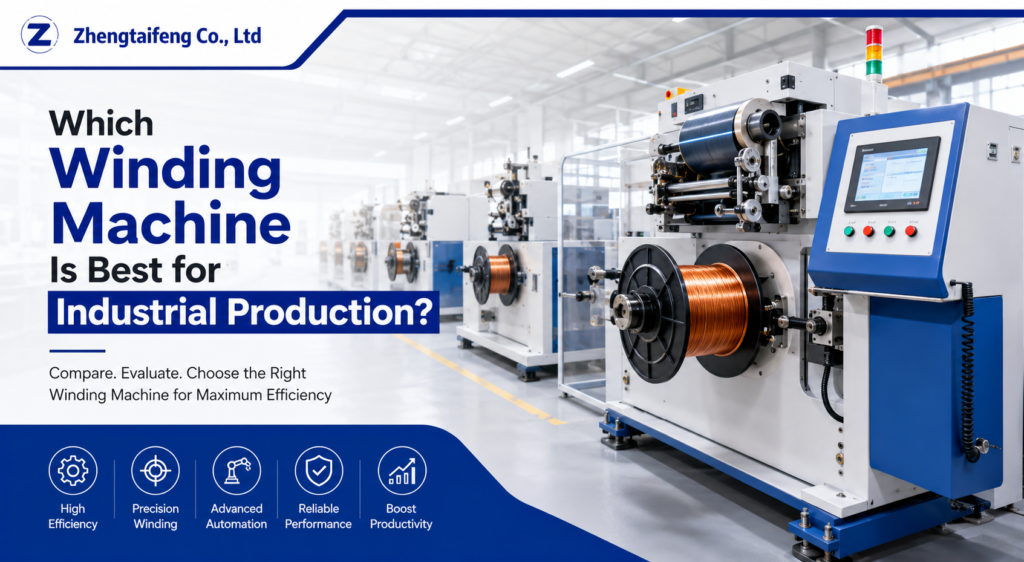
Industrial manufacturing is moving towards smarter, faster, and more precise production processes. From electrical components and transformers to automotive parts, electronics, and wire processing, manufacturers need equipment that delivers consistent quality while maintaining production efficiency. A winding machine plays an important role in achieving these goals.
However, choosing the right industrial winding machine is not always straightforward. Different manufacturing applications require different winding methods, operating speeds, tension control systems, and levels of automation. A machine suitable for producing small electronic coils might not meet the requirements of a factory manufacturing large transformer coils or industrial wire products.
With the growing adoption of smart manufacturing, automatic controls, and precision engineering, businesses are also looking beyond basic winding operations. They want equipment that reduces manual work, improves winding accuracy, minimises material waste, and supports continuous production.
So, which winding machine is best for industrial production? The answer depends on your products, production volume, material requirements, and operational goals. This guide explains the major winding machine types, their applications, and the factors manufacturers should consider before investing in industrial winding equipment.
Why Is Choosing the Right Industrial Winding Machine Important?
A winding machine is designed to wind materials such as copper wire, aluminium wire, yarn, and other flexible materials around a spool, bobbin, core, or specific component.
In industrial environments, winding accuracy directly affects the quality and performance of the finished product. Incorrect wire positioning, inconsistent tension, overlapping turns, or uneven winding patterns can lead to defective components and production delays.
Selecting suitable equipment helps manufacturers achieve several operational benefits.
1. Consistent Product Quality
A suitable winding machine maintains consistent winding patterns and material tension. This is particularly important when manufacturing electrical coils, transformers, inductors, and other precision components.
2. Improved Production Efficiency
Automatic and multi-spindle winding machines reduce repetitive manual operations. Manufacturers can increase output while making better use of available production resources.
3. Reduced Material Waste
Accurate wire positioning and controlled tension help prevent unnecessary material consumption. This improves production consistency and supports better cost management.
4. Lower Dependence on Manual Operations
Modern winding equipment supports programmable controls and automated functions. Operators spend less time performing repetitive tasks and more time monitoring production quality.
5. Better Production Flexibility
Different winding applications require different machine configurations. Selecting adaptable equipment helps manufacturers handle multiple product specifications and changing production requirements.
What Are the Different Types of Winding Machines Used in Industrial Production?
There is no single winding machine suitable for every industrial application. Each machine type has specific operating characteristics and manufacturing advantages.
Here are some commonly used options.
1. Automatic Winding Machine
An automatic winding machine is suitable for manufacturers looking to increase production capacity and reduce manual intervention.
These machines use programmed controls to manage winding operations, wire arrangement, spindle movement, and other production functions. Depending on the configuration, certain models also support automatic loading, unloading, wire trimming, and other processes.
Key benefits:
- Reduces repetitive manual operations.
- Supports higher production output.
- Maintains consistent winding patterns.
- Improves production repeatability.
- Suitable for large-volume manufacturing.
Applications: Electronic coils, transformers, inductors, automotive components, and other electrical products.
Automatic winding machines are particularly useful for factories producing standardised components in large quantities.
2. Semi-Automatic Winding Machine
Semi-automatic winding machines combine mechanical or programmed winding operations with operator involvement.
The operator typically handles material positioning, loading, unloading, or certain adjustments, while the machine performs the main winding process.
Key benefits:
- Offers a balance between automation and manual control.
- Requires a comparatively simpler operating setup.
- Supports different production requirements.
- Suitable for small and medium-sized manufacturing operations.
Applications: Electrical coils, small transformers, repair workshops, and specialised component manufacturing.
This option is worth considering when production volumes do not justify a fully automatic system.
3. Toroidal Winding Machine
A toroidal winding machine is specially designed to wind wire around ring-shaped magnetic cores.
Unlike conventional bobbin winding, toroidal winding involves passing wire through the centre of the core and around its outer surface. This process requires specialised equipment and accurate wire handling.
Key benefits:
- Supports uniform winding around ring-shaped cores.
- Helps maintain consistent coil distribution.
- Suitable for compact electrical components.
- Supports specialised transformer and inductor production.
Applications: Toroidal transformers, magnetic components, inductors, power supplies, and electronic equipment.
Manufacturers producing ring-shaped electrical components should consider this machine type when evaluating their winding requirements.
4. Multi-Spindle Winding Machine
A multi-spindle winding machine allows several winding operations to take place simultaneously.
Depending on the machine design, multiple spindles can process similar components together, improving production capacity and reducing the time required for repetitive operations.
Key benefits:
- Supports parallel production.
- Improves manufacturing throughput.
- Reduces production time per batch.
- Makes better use of available operator resources.
Applications: Solenoid coils, electronic components, transformer coils, and high-volume electrical manufacturing.
This machine is a practical option for factories where production speed and consistent output are major priorities.
5. Precision Winding Machine
A precision winding machine is designed for applications where accurate wire positioning, controlled tension, and consistent winding geometry are essential.
It is particularly useful when working with fine wires, compact coils, or components with strict technical specifications.
Key benefits:
- Supports accurate wire placement.
- Maintains controlled winding tension.
- Helps reduce winding defects.
- Improves repeatability between production batches.
Applications: Sensors, miniature coils, communication equipment, electronic components, and precision electrical products.
Manufacturers should consider precision winding equipment when product performance depends heavily on accurate coil construction.
Which Winding Machine Is Best for Different Industrial Applications?
The best machine depends on the type of product being manufactured and the expected production output.
The following comparison provides a starting point for selecting suitable equipment.
| Machine Type | Recommended Application | Main Advantage |
| Automatic Winding Machine | High-volume coil production | Reduced manual intervention |
| Semi-Automatic Winding Machine | Small and medium production | Operational flexibility |
| Toroidal Winding Machine | Ring-shaped transformer cores | Specialised winding capability |
| Multi-Spindle Winding Machine | Repetitive component production | Higher production throughput |
| Precision Winding Machine | Fine-wire and precision coils | Accurate winding control |
For manufacturers producing standard electrical coils in large quantities, an automatic or multi-spindle winding machine is often a suitable choice.
For specialised electronic components, precision winding equipment offers better control over winding accuracy.
For toroidal transformers and ring-shaped magnetic components, a dedicated toroidal winding machine is the more appropriate solution.
The important point is to match the machine’s technical capabilities with your actual manufacturing requirements rather than choosing equipment based on speed or price alone.
What Features Should You Check Before Buying an Industrial Winding Machine?
Before purchasing winding equipment, manufacturers should evaluate its technical specifications and compatibility with their production processes.
Here are seven important factors to consider.
1. Winding Accuracy
Check whether the machine maintains consistent wire positioning and winding patterns. Accuracy is especially important when producing electrical components with specific coil dimensions and turn requirements.
2. Tension Control System
Wire tension affects winding quality, material handling, and finished product consistency. A suitable tension control system helps prevent loose winding, wire breakage, and uneven material distribution.
3. Production Speed
Evaluate the machine’s operating speed according to your production targets. Higher speed is useful, but it should not compromise winding accuracy or finished product quality.
4. Automation Capabilities
Consider whether you need manual, semi-automatic, or fully automatic operation. Programmable controls and automated material handling features help reduce repetitive work.
5. Material Compatibility
Confirm that the equipment supports your required wire diameter, material type, spool dimensions, and winding specifications.
6. Maintenance Requirements
Check the availability of spare parts, technical support, maintenance procedures, and equipment servicing. A machine that is easy to maintain helps reduce unexpected production interruptions.
7. Customisation Options
Every manufacturing facility has different production requirements. Ask whether the manufacturer supports customised machine configurations, specialised fixtures, and application-specific technical adjustments.
How Are Smart Manufacturing Trends Changing Industrial Winding Machines?
Industrial winding technology is gradually moving beyond conventional mechanical operations. Manufacturers increasingly focus on automation, precision control, production monitoring, and energy efficiency.
Several developments are influencing equipment selection.
Servo Motor Technology
Servo-driven systems offer precise control over motor movement, speed, and positioning. When properly configured, they help maintain consistent winding operations and improve production control.
Programmable Control Systems
Programmable logic controllers (PLCs) and numerical control systems allow manufacturers to manage machine operations through predefined settings. This makes production adjustments more systematic and repeatable.
Automated Material Handling
Automatic loading, unloading, wire arrangement, and trimming features help reduce manual intervention. These functions are particularly valuable in high-volume manufacturing environments.
Intelligent Tension Management
Controlled wire tension is essential for producing consistent coils. Electronic and servo-based tension control systems help manufacturers maintain stable material handling during winding operations.
Production Monitoring and Data Integration
Connected manufacturing equipment supports better visibility into machine performance, production output, and operating conditions. Integration with factory monitoring systems helps businesses identify operational issues and improve production planning.
These developments demonstrate why manufacturers should evaluate more than basic winding speed when selecting industrial equipment. Precision, automation, flexibility, and long-term operating efficiency are equally important.
Why Choose Zhengtaifeng Co., Ltd. for Industrial Winding Machines?
Selecting an experienced equipment manufacturer is an important part of making a reliable investment.
Zhengtaifeng Co., Ltd. specialises in winding machine equipment, tension control systems, wire processing components, and related industrial products. The company offers different winding machine solutions designed for various manufacturing applications.
Its winding machine product range includes different equipment configurations, such as:
- SHL Series: Winding machine solutions for specialised industrial applications.
- GR Series: Winding equipment options for different production requirements.
- XT Series: Additional winding machine configurations for industrial use.
The company also offers specialised equipment, including automatic solenoid valve coil winding machines, slider-type automatic toroidal coil winding machines, and multi-spindle winding solutions.
Alongside winding machines, Zhengtaifeng provides wire tensioners, ceramic components, and other related industrial products that support wire handling and manufacturing processes.
Manufacturers looking for customised equipment can discuss their application requirements and technical specifications with the company.
To explore the available equipment and product configurations, visit the Zhengtaifeng Industrial Winding Machine Collection.
Frequently Asked Questions About Industrial Winding Machines
1. Which winding machine is best for industrial production?
An automatic winding machine is often suitable for high-volume manufacturing. However, the best option depends on the product type, wire specifications, production capacity, and required winding accuracy.
2. What is the difference between automatic and semi-automatic winding machines?
An automatic winding machine performs more operations through programmed controls, reducing manual intervention. A semi-automatic machine requires operator involvement in certain stages, such as material loading, unloading, or adjustments.
3. Which winding machine is suitable for transformer manufacturing?
The choice depends on transformer design. Automatic coil winding machines, toroidal winding machines, and specialised transformer winding equipment are used for different transformer core and coil configurations.
4. Why is tension control important in winding machines?
Tension control maintains consistent material handling during winding. It helps prevent wire breakage, uneven winding, loose coils, and other production defects.
5. Can an industrial winding machine handle different wire materials?
Many industrial winding machines support different wire materials, including copper and aluminium. However, compatibility depends on the machine design, wire diameter, tension requirements, and application specifications.
6. Are automatic winding machines suitable for small manufacturing businesses?
Yes. Small manufacturers with repetitive production requirements can benefit from automation. However, they should evaluate the initial investment, expected production volume, operating costs, and return on investment before purchasing.
7. What should manufacturers consider before purchasing a winding machine?
Manufacturers should evaluate winding accuracy, production speed, tension control, automation level, material compatibility, maintenance requirements, and customisation options.
8. Can winding machines be customised for specific production requirements?
Some manufacturers offer customised machine configurations based on product dimensions, winding patterns, wire specifications, and production requirements. Buyers should discuss their technical drawings and application details before finalising an order.
Final Thoughts
Choosing the right industrial winding machine is an important decision for manufacturers looking to improve production efficiency and maintain consistent product quality.
Automatic, semi-automatic, toroidal, multi-spindle, and precision winding machines each serve different manufacturing purposes. The right investment depends on your production volume, material specifications, winding accuracy, and automation requirements.
As industrial manufacturing continues to adopt smarter production technologies, equipment with reliable tension control, programmable operations, and flexible configurations is becoming increasingly valuable.
Zhengtaifeng Co., Ltd. offers a range of winding machine solutions for different industrial applications. Reviewing the available models and discussing your production requirements with an experienced manufacturer will help you identify suitable equipment.
Looking for the right winding machine for your factory? Explore Zhengtaifeng’s industrial winding machine range today and contact the team to discuss your application requirements, technical specifications, and customised equipment solutions.