

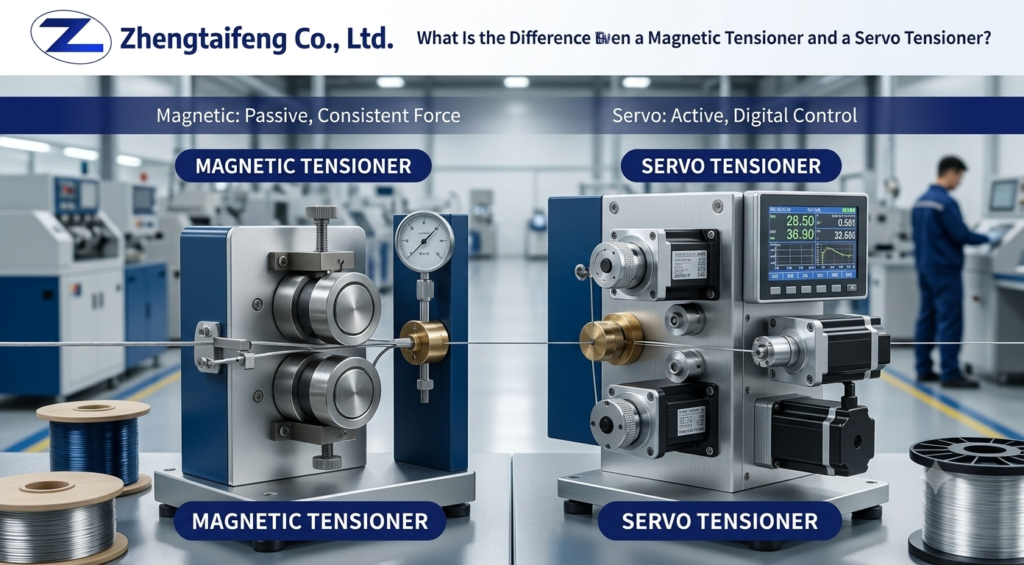
In precision winding, small variations in wire tension can make a noticeable difference to the quality, consistency, and reliability of the finished product. Whether a manufacturer produces transformer coils, motor windings, inductors, or electronic components, maintaining controlled wire tension is essential for achieving repeatable results.
Two commonly considered solutions are magnetic tensioners and servo tensioners. Both are designed to manage wire tension during winding, but they use different operating principles and offer different levels of control. Choosing between them depends on the wire material, winding speed, tension requirements, machine configuration, and production objectives.
As winding operations move toward higher automation and more precise process control, manufacturers are paying closer attention to how tensioning equipment affects productivity and product quality. Understanding the differences between magnetic and servo tensioners can help engineers and procurement teams select equipment that matches their actual manufacturing requirements.
This guide explains how each tensioner works, compares its advantages and limitations, and outlines the factors to consider when choosing a solution for modern winding applications.
What Is a Magnetic Tensioner?
A magnetic tensioner is a wire tension control device that uses magnetic force to create resistance during wire movement. This resistance helps maintain the required tension as wire passes through the tensioner and into a winding machine.
In many magnetic tensioner designs, permanent magnets control the resistance applied to a tension wheel. Adjusting the magnetic arrangement changes the braking effect, allowing the operator to set a suitable tension level for the application.
Because magnetic force can generate resistance without relying entirely on direct friction between mechanical components, this design can reduce wear associated with conventional friction-based tensioning mechanisms.
How Does a Magnetic Tensioner Work?
During winding, wire travels from a supply spool through the tensioning mechanism and toward the winding head. The magnetic tensioner applies controlled resistance to the wire path, helping prevent loose winding and maintaining consistent wire placement.
The operator typically adjusts the tension setting according to the wire diameter, material, and winding requirements. Depending on the design, a tension arm or other mechanical element may respond to changes in wire movement and help regulate the process.
The main operating principle is relatively straightforward: magnetic resistance helps control the force required to pull wire through the system.
For example, when winding fine enamelled copper wire, excessive tension may damage the insulation or cause the wire to break. Insufficient tension, meanwhile, can result in loose turns and inconsistent coil geometry. A correctly selected magnetic tensioner helps maintain a suitable balance.
Zhengtaifeng Co., Ltd offers magnetic tensioner options, including its NMTC series, which uses permanent magnets to regulate tension through the gap between the magnets and the main tension wheel. The manufacturer also describes design features intended to reduce wire jumping and jamming. These features may be useful for applications where stable wire movement is a priority.
Key Advantages of Magnetic Tensioners
1. Straightforward tension adjustment
Magnetic tensioners generally allow operators to adjust resistance through a manual setting. This makes them practical for production environments where the tension requirement remains relatively consistent throughout the winding cycle.
2. Reduced mechanical wear
Non-contact magnetic resistance can reduce dependence on friction between moving components. This may help maintain performance over repeated production runs, although bearings, guides, and other components still require inspection.
3. Practical operating costs
For applications that do not require active motor-driven wire feeding, a magnetic tensioner may provide an economical way to achieve controlled tension without adding more complex control equipment.
4. Suitable for established winding processes
Magnetic tensioners can be a good fit for machines that use relatively stable winding parameters and do not require frequent, programmed changes in tension.
5. Consistent results when correctly configured
A suitable model, properly adjusted for the wire and operating conditions, can help maintain repeatable winding quality. Actual performance depends on the tension range, machine dynamics, wire characteristics, and maintenance practices.
What Are the Limitations of Magnetic Tensioners?
A magnetic tensioner is not automatically the best choice for every precision winding application.
Its tension adjustment is commonly based on the resistance setting rather than active motor-driven wire delivery. As a result, a conventional magnetic design may have less flexibility when the process requires rapid changes in tension or coordinated adjustments with the winding machine.
Operators may also need to verify the setting when changing wire diameters, winding programs, or production conditions.
For applications with demanding acceleration profiles, very delicate wire, or different tension requirements at different stages of a winding cycle, a servo-based solution may offer greater control.
What Is a Servo Tensioner?
A servo tensioner is an active wire tension control device that uses a motor-driven mechanism to regulate wire delivery and maintain the required tension.
Rather than relying primarily on passive resistance, a servo tensioner can actively feed wire according to the demands of the winding process. Depending on the model, it may use a tension feedback system to monitor operating conditions and adjust motor action to help stabilize the wire.
This approach is particularly relevant when winding equipment needs to respond to changes in speed, wire demand, or process requirements.
How Does a Servo Tensioner Work?
A servo tensioner supplies wire using a controlled motor-driven mechanism. The winding machine draws wire as the coil develops, while the tensioner regulates delivery to help maintain the required tension.
In feedback-enabled designs, information about tension or the mechanism’s operating position is used to adjust the system. This helps the equipment respond to changes that could otherwise create excessive tension or slack.
For example, if the winding machine accelerates, the wire demand may increase quickly. An appropriately configured servo tensioner can adjust its wire delivery to follow the process more effectively than a system relying only on a fixed resistance setting.
Zhengtaifeng Co., Ltd describes its SET Standard Series servo tensioner as using motor-driven wire delivery and a tension feedback stabilization system. The manufacturer highlights stable tension and easier adjustment as key features. The product’s operating range and suitability should be confirmed against the requirements of the intended machine.
Key Advantages of Servo Tensioners
1. Active wire delivery
A motor-driven feed mechanism can help match wire delivery to the changing requirements of the winding machine. This is useful in processes where wire demand changes significantly during operation.
2. Improved process adaptability
Servo tensioners can be suitable for applications that involve changing winding speeds, demanding acceleration and deceleration, or more complex production sequences.
3. Potential for more consistent precision winding
When correctly selected and configured, active tension control can help reduce variations that affect coil geometry, wire placement, and finished-product consistency.
4. Support for automated production
Servo tensioners may integrate with suitable winding machine controls, allowing tension settings and operating sequences to be coordinated with a broader automated process. Available control functions depend on the specific model and machine interface.
5. Greater flexibility for demanding applications
Where the required tension changes during the winding cycle, a suitable servo tensioner may provide more flexibility than a conventional magnetic tensioner with a manually adjusted resistance setting.
What Are the Limitations of Servo Tensioners?
Servo tensioners introduce additional considerations.
They require electrical power and may need compatible control signals, suitable mounting arrangements, and commissioning by personnel familiar with the winding machine. The overall installation can be more involved than fitting a straightforward passive tensioning device.
Purchase cost, integration requirements, and maintenance considerations should be evaluated against the expected production benefits. A servo tensioner may be unnecessary for a stable winding process that does not benefit from active control.
It is also important to distinguish between motor-driven wire feeding and closed-loop tension regulation. Not every servo tensioner offers identical feedback functions, programming options, or control accuracy. Buyers should verify the capabilities of the specific model rather than relying on the product category alone.
What Is the Difference Between a Magnetic Tensioner and a Servo Tensioner?
The main difference is how each device controls wire movement and tension. A magnetic tensioner generally creates adjustable resistance using magnetic force, while a servo tensioner actively drives wire delivery through a motor-controlled mechanism.
The following comparison highlights the key differences.
| Comparison factor | Magnetic tensioner | Servo tensioner |
| Operating principle | Magnetic resistance regulates wire tension | Motor-driven wire feeding actively manages delivery |
| Main control approach | Usually a manually adjusted resistance setting | Motor control, with feedback features depending on the model |
| Tension adjustment | Generally straightforward manual adjustment | May support more responsive adjustment and programmed control |
| Changing winding speeds | Performance depends on the design and operating conditions | Can adapt wire delivery to changing demand when properly configured |
| Automation | Suitable for many conventional winding setups | Often better suited to applications requiring coordinated active control |
| Installation | Often simpler where no advanced integration is needed | May require electrical and control-system integration |
| Initial investment | Often economical for suitable applications | Can involve higher equipment and integration costs |
| Best-fit application | Stable processes with established tension requirements | Demanding processes requiring active wire-feed control |
| Selection priority | Appropriate tension range and reliable operation | Control capability, feedback behavior, and machine compatibility |
Neither type is universally superior. The right choice depends on the level of tension control required and the complexity of the winding process.
Which Tensioner Is Better for High-Speed Winding?
High-speed winding requires more than simply selecting equipment with a high rated wire speed. The tensioner must respond appropriately to acceleration, deceleration, changing wire demand, and the physical characteristics of the wire.
A magnetic tensioner can be suitable for high-speed production when its specifications and operating characteristics match the winding application. However, a fixed or manually adjusted resistance setting may not provide the flexibility required by every high-speed process.
A servo tensioner may be preferable when the machine frequently changes speed or when wire delivery must actively follow the winding cycle. Its ability to regulate feed can help reduce tension disturbances, provided the motor response, control configuration, and wire path are appropriate.
Before choosing either option, verify:
- Maximum operating wire speed.
- Required tension range and allowable variation.
- Wire diameter and material.
- Acceleration and deceleration characteristics.
- Wire breakage and insulation damage risks.
- Compatibility with the existing winding machine.
The most suitable tensioner is the one that maintains acceptable tension throughout the real production cycle, not simply the one with the highest advertised speed.
Which Tensioner Is Better for Fine Wire and Delicate Materials?
Fine wire presents a particular challenge because its allowable tension may be limited. Excessive pulling force can cause breakage, deform the wire, or damage enamel insulation. Even small inconsistencies may affect the finished coil.
A magnetic tensioner can work well when the required tension remains stable and the model supports the necessary low-tension range. Buyers should pay attention to adjustment resolution, wire guides, and the repeatability of the tension setting.
A servo tensioner may be advantageous when wire delivery changes rapidly or the winding process requires more active control. However, a servo model is not automatically more accurate in every application. Its actual performance depends on the feedback method, control response, wire path, and setup.
When sourcing equipment for fine wire, request the manufacturer’s recommended wire diameter range, minimum controllable tension, operating speed, and testing conditions. If possible, arrange a trial using the actual wire and winding parameters.
How Do You Choose the Right Tensioner for Your Winding Machine?
The best selection process begins with the application rather than the equipment name. A tensioner should match the material, production requirements, and machine configuration.
1. Define the Required Tension Range
Determine the minimum and maximum tension required during winding. Include any differences between startup, normal operation, and stopping.
Avoid choosing a model based only on its maximum tension rating. The device must also operate reliably at the lower end of your required range.
2. Confirm the Wire Diameter and Material
Copper wire, enamelled wire, fine conductive wire, and other materials have different mechanical characteristics.
Confirm the supported wire diameter range and whether the guides and rollers are suitable for the material. For insulated wire, pay particular attention to surface finish and the risk of coating damage.
3. Evaluate the Winding Speed Profile
Consider the actual operating cycle, including sudden starts, speed changes, deceleration, and emergency stops.
A process with relatively constant speed may work well with a magnetic tensioner. A process with frequent dynamic changes may benefit from a servo tensioner with suitable control capabilities.
4. Identify Whether Tension Must Change During the Cycle
Some applications need one stable tension setting. Others require different tension levels during winding, terminal wrapping, or other stages.
If tension must change automatically, check whether the selected tensioner supports the required control signals, operating modes, and adjustment behavior.
5. Check Machine Compatibility
Verify the available mounting space, wire path, electrical supply, and control interface. For servo equipment, confirm whether the machine controller can communicate with the tensioner as required.
6. Consider Maintenance and Operating Costs
Compare more than the initial purchase price. Consider installation, operator training, routine inspection, spare parts, downtime, and the cost of defective coils.
A simpler device may offer better value for stable production. A more advanced system may justify its cost when improved control reduces scrap, interruptions, or repeated manual adjustments.
7. Request Application-Specific Technical Information
Before placing a bulk order, request the relevant technical specifications and confirm that the proposed model meets your operating requirements.
Where precision is critical, ask about measured tension stability, repeatability, response to speed changes, and the conditions under which performance was tested.
Why Does Tension Control Matter in Modern Precision Winding?
Tension control influences how wire is positioned and compacted as it forms a coil. If tension varies excessively, the winding may become loose, uneven, or inconsistent. Excessive tension can damage wire or insulation, while insufficient tension can affect coil shape and stability.
These issues can create quality problems, increase inspection requirements, and contribute to production waste.
Modern manufacturing places greater emphasis on repeatability, process monitoring, and reduced manual intervention. Choosing a tensioner that matches the winding machine can support these objectives, but the device must be configured correctly and evaluated under actual production conditions.
A useful approach is to treat tension control as one part of the complete winding system. Wire supply, guides, winding speed, machine programming, and operator procedures all influence the final result.
Why Consider Zhengtaifeng Co., Ltd for Tensioner Solutions?
Zhengtaifeng Co., Ltd supplies wire tensioning equipment for winding applications, including magnetic tensioners and servo tensioner options.
Its product range includes magnetic tensioner models such as the NMTC series and servo tensioner models such as the SET Standard Series. These product families provide options for manufacturers with different tension ranges, wire sizes, and process-control requirements.
When evaluating equipment from Zhengtaifeng, buyers should identify their required wire diameter, tension range, operating speed, and control needs before selecting a model.
For servo applications, confirm the available feedback and integration features. For magnetic applications, verify the adjustment range and suitability for the intended winding cycle.
You can review the Zhengtaifeng servo tensioner range to explore the available product information and determine which specifications are relevant to your application.
The goal is not simply to purchase a tensioner. It is to select equipment that supports consistent winding quality, reliable operation, and the practical needs of your production line.
Frequently Asked Questions
1. What is the main difference between a magnetic tensioner and a servo tensioner?
A magnetic tensioner generally uses magnetic resistance to regulate wire movement, while a servo tensioner uses a motor-driven mechanism to control wire delivery. Servo models may offer more flexibility for applications that require active adjustment or changing operating conditions.
2. Is a magnetic tensioner suitable for precision winding?
Yes. A correctly selected magnetic tensioner can provide consistent tension for many precision winding applications. Suitability depends on the required tension range, wire characteristics, operating speed, and the stability needed throughout the winding cycle.
3. Are servo tensioners better for high-speed winding machines?
They can be advantageous when high-speed winding involves frequent acceleration, deceleration, or changing wire demand. However, suitability depends on the specific model’s speed rating, control response, and compatibility with the winding machine.
4. Can a servo tensioner reduce wire breakage?
A properly configured servo tensioner may help reduce breakage by regulating wire delivery and limiting tension disturbances. It cannot eliminate every cause of wire breakage, which may also result from damaged wire, incorrect guides, unsuitable tension settings, or machine faults.
5. Which tensioner is more economical?
A magnetic tensioner may have a lower initial cost and simpler installation for stable applications. A servo tensioner may offer better overall value when active control improves process consistency or reduces production losses. Total operating cost should guide the decision.
6. Can I replace a magnetic tensioner with a servo tensioner?
Potentially, but compatibility must be checked first. Review mounting dimensions, wire routing, electrical requirements, control signals, operating speed, and tension range. A replacement may also require adjustments to the winding machine’s settings or control program.
7. What specifications should I provide when requesting a tensioner quotation?
Provide the wire material, wire diameter, minimum and maximum tension, operating speed, winding machine model, required control functions, and expected production conditions. Include any special requirements for fine wire, insulation protection, or automatic tension changes.
8. Does every servo tensioner provide closed-loop tension control?
No. Servo tensioners differ in their feedback systems and control capabilities. Some incorporate tension feedback stabilization, while others may use different control arrangements. Confirm the exact functions and measurable performance of the model before purchasing.
Final Thoughts
Choosing between a magnetic tensioner and a servo tensioner comes down to the demands of your winding process. Magnetic tensioners can be practical, economical solutions for applications with relatively stable tension requirements. Servo tensioners can offer greater flexibility when active wire delivery, changing operating conditions, or integration with automated equipment is important.
The best decision comes from matching the tensioner’s capabilities to the wire material, tension range, machine speed, and required production consistency.
Looking for the right tensioner for your winding application? Explore Zhengtaifeng Co., Ltd’s servo tensioner solutions and contact the team with your wire specifications and operating requirements to identify a suitable option for your production line.