

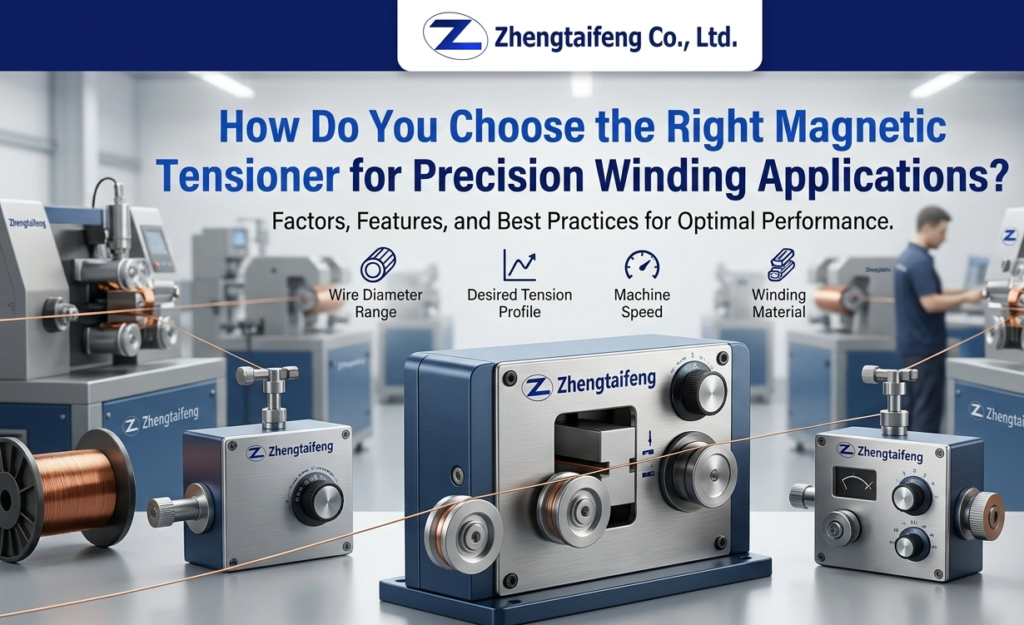
Precision winding depends on more than machine speed and winding patterns. The amount of tension applied to the wire or filament throughout the process also influences winding consistency, material handling, coil quality, and production efficiency. When tension fluctuates, manufacturers may experience wire breakage, uneven coils, inconsistent winding density, or unnecessary machine adjustments.
This is why selecting the right magnetic tensioner is an important decision for manufacturers working with fine wires, copper conductors, electrical coils, and other precision-wound products.
As manufacturing moves toward greater automation, tighter process tolerances, and more consistent production quality, buyers are paying closer attention to tension control equipment. A magnetic tensioner can provide a practical solution for applications that require controlled resistance during winding, but the correct choice depends on material properties, operating conditions, required tension, and machine compatibility.
So, how do you choose a magnetic tensioner that matches your production requirements?
The key is to evaluate the complete winding process rather than selecting a unit based on price or product appearance alone. This guide explains the main selection criteria, common mistakes to avoid, and the questions to discuss with a manufacturer before purchasing.
What Is a Magnetic Tensioner and Why Does It Matter in Precision Winding?
A magnetic tensioner is a device designed to regulate the tension of wire or another continuous material as it moves through a winding system. Depending on its design, it uses magnetic force to generate controlled resistance, helping maintain more consistent tension as material feeds toward the winding point.
In conventional winding operations, unstable tension can affect the way material is distributed across a bobbin or coil. Excessive tension may stretch, deform, or break delicate wire, while insufficient tension can produce loose winding, irregular layers, and unstable packages.
Magnetic tensioners are used in a range of winding applications, including:
- Copper and enamelled wire winding
- Electrical coil and transformer manufacturing
- Fine-wire processing
- Cable and conductor production
- Textile filament and yarn handling
- Automated winding equipment
The suitability of a particular model depends on its tension range, compatible material diameter, mechanical arrangement, and operating conditions.
For example, a tensioner intended for fine enamelled wire may not be appropriate for a thicker conductor that requires a substantially higher tension range. Selecting the right specification helps manufacturers achieve the intended winding performance without placing unnecessary stress on the material.
How Should You Match a Magnetic Tensioner to Your Material?
Material compatibility should be one of the first checks when evaluating a magnetic tensioner. Different materials respond differently to tension, and their physical characteristics determine how much pulling force they can tolerate during winding.
1. Identify the Material Type
Start by identifying the material that will pass through the tensioning system. Copper wire, enamelled wire, coated conductors, textile filaments, and other materials may require different handling conditions.
Fine enamelled wire, for example, needs careful tension management because excessive force can damage its insulation or affect its shape. A heavier conductor may require a different operating range to maintain stable winding.
Provide the supplier with the exact material type and any relevant coating, surface, or handling requirements. This makes it easier to identify a suitable configuration.
2. Confirm the Material Diameter
Wire diameter is a critical factor in model selection. Thin wire generally requires a different tensioning range from thicker wire, and the tensioner must accommodate the actual diameter used in production.
Avoid selecting a unit simply because it is described as suitable for wire winding. Ask for the supported diameter range and the corresponding tension range for the specific model.
If your production line processes several wire diameters, explain the full operating range rather than providing only the most frequently used size. A model that performs well with one material may not deliver the same results across every product specification.
3. Establish the Required Tension
The required tension should be determined by the material, winding geometry, machine speed, and quality requirements.
Too much tension can cause material damage, breakage, deformation, or excessive stress. Too little tension can lead to loose coils, irregular winding patterns, and poor package stability.
Where possible, provide the supplier with measured tension requirements instead of relying on general descriptions such as low tension or high tension.
It is also useful to distinguish between the normal operating tension and any changes that occur during acceleration, deceleration, or machine stops. These details help determine whether a conventional magnetic tensioner is sufficient or whether a more advanced control arrangement is needed.
Which Tension Range Should You Choose?
A suitable tension range allows the device to operate within the working conditions required by your production process. Choosing the wrong range can make adjustment difficult or prevent the system from maintaining the desired tension.
Before selecting a model, consider three important factors.
Minimum operating tension: Determine the lowest tension required by your most delicate material or product configuration.
Maximum operating tension: Establish the highest tension needed for your heaviest material or most demanding winding condition.
Normal production range: Identify the tension values used most frequently during regular operation.
The normal operating range deserves particular attention. A tensioner should not be selected only because its maximum capacity exceeds your highest requirement. The device must also be appropriate for the tension levels used throughout the production cycle.
For multi-product manufacturing, consider the tension requirements of each material and winding setup. Discuss whether one unit can accommodate the full range or whether different models would provide more suitable performance.
Manufacturers should request the relevant technical specifications and verify them under their actual operating conditions.
How Does Winding Speed Affect Magnetic Tensioner Selection?
Winding speed can influence tension stability, particularly when a machine frequently accelerates, decelerates, or changes operating conditions.
A tensioner that performs satisfactorily at a steady speed may behave differently during rapid transitions. Material inertia, guide arrangements, spool characteristics, and the tensioner’s own mechanical response can all affect the result.
When evaluating a magnetic tensioner, consider the following:
- Normal and maximum line speed
- Frequency of machine starts and stops
- Acceleration and deceleration requirements
- Changes in spool diameter during winding
- Wire travel path and guide arrangement
- Acceptable tension variation during operation
These factors help establish whether a passive magnetic tensioning mechanism meets the application’s requirements.
For stable, repetitive winding tasks, a suitable magnetic unit may offer a practical and straightforward solution. For applications involving frequent changes in tension demand or tightly controlled dynamic performance, a servo tensioner or another active control system may deserve consideration.
The correct choice depends on the required process performance, not simply on whether the machine operates at a high or low speed.
Should You Choose a Magnetic Tensioner with a Cylinder?
A magnetic tension unit with a cylinder may be suitable for applications that require a specific mechanical arrangement or additional tensioning functionality. However, the presence of a cylinder alone does not guarantee better performance in every winding process.
Buyers should first understand how the cylinder functions within the proposed configuration and whether it supports the operating requirements of the machine.
Consider the following questions:
- Does the application require an additional mechanical action during winding?
- Must the tensioning arrangement respond to a particular machine sequence?
- Is there sufficient space for the unit and its associated components?
- What pneumatic or other operating connections are required, if applicable?
- How does the proposed arrangement affect adjustment and maintenance?
- Is the unit compatible with the existing winding equipment?
These questions help distinguish between applications that need a standard magnetic tensioner and those that may benefit from a cylinder-equipped configuration.
Zhengtaifeng Co., Ltd offers a magnetic tension unit with cylinder for winding equipment applications. Buyers should review the product’s detailed specifications and confirm the operating principle, model compatibility, and installation requirements with the supplier before finalising a selection.
Magnetic Tensioner vs Servo Tensioner: Which Is Better?
Magnetic and servo tensioners serve related purposes, but they use different approaches to tension management. Understanding this distinction can prevent manufacturers from investing in equipment that does not match their process requirements.
A magnetic tensioner typically uses magnetic resistance to provide controlled tension. Depending on the model, this can offer a comparatively simple arrangement for applications where the required tension remains within a defined operating range.
A servo tensioner uses a motor-driven mechanism and may incorporate tension feedback to adjust operation in response to changing conditions. This can be useful when a process requires more active control.
| Selection factor | Magnetic tensioner | Servo tensioner |
| Tension generation | Magnetic resistance, depending on design | Motor-driven control |
| Control approach | Typically passive or mechanically adjusted | May use active feedback and adjustment |
| System complexity | Often simpler | Generally requires more control components |
| Changing tension demands | Depends on the model and application | Can be suitable for dynamic requirements |
| Integration considerations | Mechanical fit and tension range | Mechanical, electrical, and control compatibility |
| Best selection basis | Stable, defined operating requirements | Applications requiring more responsive tension control |
Neither option is automatically superior. A servo system may be unnecessary for a process with stable tension requirements, while a basic magnetic unit may not provide the level of active adjustment needed for a demanding application.
The most appropriate option is the one that meets the required tension stability, production speed, integration needs, and total operating cost.
What Mechanical and Installation Details Should Buyers Check?
Even a technically suitable tensioner can create problems if it is difficult to install or does not align with the winding machine.
Before ordering, verify the available mounting space, fixing dimensions, material path, guide arrangement, and access required for adjustment. The position of the tensioner relative to the supply spool and winding point can influence how material travels through the system.
Also consider whether the installation requires changes to existing brackets, pneumatic connections, electrical interfaces, or machine controls.
For replacement projects, do not rely exclusively on the previous unit’s model name. Confirm the actual dimensions and operating specifications, especially if the equipment has been modified since its original installation.
For new machine builds, share the relevant assembly drawings or mounting requirements with the manufacturer. This can help identify compatibility issues before equipment arrives at the production facility.
How Can You Evaluate Tension Stability and Winding Quality?
Technical specifications are an essential starting point, but production performance should also be evaluated through practical testing.
A suitable tensioner should support the required winding process without introducing unacceptable tension fluctuations or material damage. The exact acceptance criteria depend on the application and the manufacturer’s process requirements.
A useful evaluation process includes:
- Measure tension: Check the tension at the relevant point in the material path using an appropriate measuring instrument.
- Test at normal operating speed: Evaluate the unit under representative production conditions.
- Observe winding consistency: Inspect the coil or package for loose layers, irregular distribution, and other quality issues.
- Check material condition: Look for wire breakage, coating damage, deformation, or other signs of excessive stress.
- Repeat the test: Confirm that performance remains acceptable across repeated runs and relevant operating conditions.
- Document adjustments: Record the model, material specification, operating speed, tension settings, and observed results.
Where the process requires narrow tension tolerances, define the acceptance limits before testing. A statement that a tensioner provides stable tension is not a substitute for application-specific verification.
For production lines processing different materials, repeat the evaluation for each important product configuration.
What Maintenance Factors Should Influence Your Decision?
Maintenance requirements affect equipment reliability, production continuity, and the cost of ownership.
Although magnetic tensioners can offer a relatively straightforward tensioning arrangement, their performance still depends on correct installation, suitable operating conditions, and proper care.
Before purchasing, ask the manufacturer about recommended inspection intervals, cleaning procedures, adjustment methods, and replacement parts.
Pay particular attention to wire guides, rollers, bearings, moving components, and other parts that may experience wear. Dirt, residue, damaged surfaces, or misalignment can interfere with smooth material movement.
Operators should also know how to identify unusual vibration, inconsistent tension, abnormal wear, and recurring wire breakage. These symptoms may indicate an adjustment issue, a worn component, an unsuitable model, or a problem elsewhere in the winding system.
A clear maintenance procedure helps production teams identify problems early and reduces dependence on repeated trial-and-error adjustments.
How Can You Compare Magnetic Tensioner Suppliers?
Price is an important purchasing consideration, but it should not be the only deciding factor. A low-cost tensioner that does not match the application’s material range or operating requirements can create additional production costs.
When comparing suppliers, evaluate the following areas.
Technical model selection: Can the supplier recommend a model based on your wire diameter, tension range, and winding conditions?
Specification clarity: Are operating limits, dimensions, installation details, and applicable test conditions clearly documented?
Application support: Can the supplier help resolve compatibility questions before an order is placed?
Product consistency: Can the supplier explain how product specifications and quality checks are maintained?
Customisation options: If the standard configuration is unsuitable, can the supplier assess whether an alternative specification or arrangement is feasible?
Spare parts and maintenance: Are replacement components and technical guidance available for the expected service life of the equipment?
Commercial requirements: Confirm lead time, minimum order quantity, warranty terms, packaging, and shipping arrangements.
For OEMs and equipment integrators, consistency across multiple units is particularly important. Request the documentation needed to verify that the selected model meets the same requirements across the intended production batch.
Common Mistakes to Avoid When Buying a Magnetic Tensioner
Several purchasing mistakes can lead to avoidable production issues.
Selecting Only by Price
Two tensioners that look similar may have different operating ranges, construction details, and performance characteristics. Compare technical suitability before comparing quotations.
Ignoring the Actual Wire Diameter
A broad product description does not confirm that a unit is appropriate for every wire size. Verify the exact diameter range against the model specification.
Overlooking Dynamic Operating Conditions
A tensioner that works under steady conditions may not meet requirements during rapid starts, stops, or changing winding conditions. Include these scenarios in the selection process.
Assuming Every Magnetic Tensioner Works the Same Way
Magnetic tensioners vary in design, adjustment method, construction, and intended application. Confirm the technical details instead of treating product categories as interchangeable.
Failing to Test Before Full Deployment
Where production risk is significant, evaluate the selected configuration under representative operating conditions before rolling it out across multiple machines.
Providing Incomplete Information to the Supplier
A request that simply states magnetic tensioner required may not provide enough information for a meaningful recommendation. Include material details, operating parameters, machine requirements, and expected production conditions.
Why Consider Zhengtaifeng Co., Ltd for Magnetic Tensioning Equipment?
Choosing the right supplier involves more than finding a product listing. Manufacturers need to establish whether the proposed equipment fits their material specifications, machine configuration, and production goals.
Zhengtaifeng Co., Ltd supplies winding equipment and tension control products for industrial applications. Its product range includes magnetic tensioners and servo tensioners, allowing buyers to investigate different approaches according to their operating requirements.
For buyers considering a magnetic tension unit with a cylinder, the next step is to review the available model information and discuss the application directly with the company.
Before requesting a quotation, prepare the following information:
- Material type and wire diameter
- Required minimum, normal, and maximum tension
- Winding machine model or configuration
- Normal and maximum operating speed
- Details of any cylinder or control requirements
- Mounting dimensions and available installation space
- Expected quantity and delivery requirements
Providing these details helps the supplier assess the application more accurately and identify the most relevant product options.
You can review the magnetic tension unit with cylinder and contact Zhengtaifeng Co., Ltd to discuss your requirements.
Frequently Asked Questions
1. What is the main purpose of a magnetic tensioner?
A magnetic tensioner regulates resistance applied to wire or another continuous material during winding. It helps maintain the tension needed for consistent material feeding and winding quality.
2. How do I select a magnetic tensioner for fine wire?
Start with the exact wire diameter, material type, required tension range, and operating speed. Confirm that the proposed model is designed for those conditions, and verify its performance through suitable testing.
3. Can one magnetic tensioner handle multiple wire diameters?
Some models may accommodate several wire diameters, but compatibility depends on the model’s supported material range and tension characteristics. Confirm the full range of materials used in your production process before purchasing.
4. Is a magnetic tensioner suitable for high-speed winding?
It may be suitable for certain high-speed applications, depending on its design and specified operating conditions. Buyers should verify the rated conditions and test tension stability at their actual production speed.
5. When should I choose a servo tensioner instead?
Consider a servo tensioner when the application requires active tension adjustment, feedback-based control, or a response to changing operating conditions. The final decision should be based on the process requirements and the capabilities of the available models.
6. What is the benefit of a magnetic tension unit with a cylinder?
A cylinder-equipped unit may support particular mechanical or operating requirements within a winding system. Its actual benefits depend on the configuration, so buyers should confirm the cylinder’s function, required connections, and compatibility with their machine.
7. What information should I provide when requesting a quotation?
Provide the material type, wire diameter, tension requirements, operating speed, winding machine details, installation dimensions, required configuration, and order quantity. Drawings or photographs of the existing setup can also help clarify compatibility requirements.
8. How can I check whether a magnetic tensioner is performing correctly?
Measure tension using a suitable instrument, observe winding quality, inspect the material for damage, and test the unit under representative operating conditions. Compare the results with predefined acceptance criteria for the application.
Final Thoughts
Choosing the right magnetic tensioner for precision winding requires a clear understanding of material characteristics, tension requirements, operating speed, machine compatibility, and maintenance needs.
The best selection is not necessarily the most powerful or expensive unit. It is the configuration that delivers the required tension performance while supporting consistent winding quality and reliable production.
By defining your operating requirements before contacting a supplier, you can narrow the available options, reduce compatibility risks, and make a more informed purchasing decision.
Looking for a magnetic tension unit with a cylinder for your winding equipment? Contact Zhengtaifeng Co., Ltd today to discuss your application requirements and identify a suitable tensioning solution for your production line.