

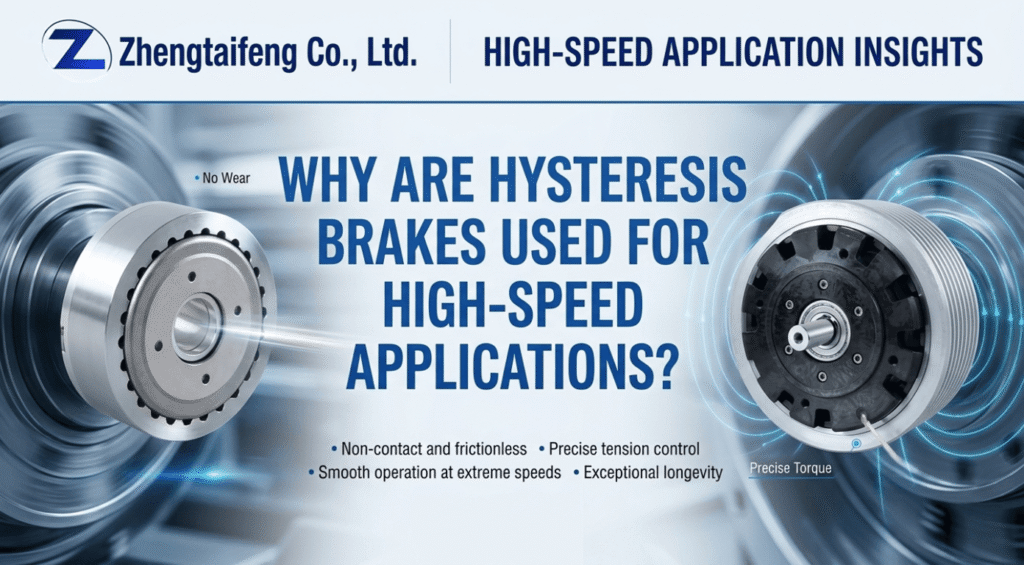
High-speed machinery requires braking systems that can deliver controlled torque without excessive wear, vibration, or inconsistent performance. In applications such as motor testing, wire and cable winding, web tension control, dynamometers, and other rotating equipment, the brake may need to operate continuously while the shaft runs at thousands of revolutions per minute.
This is where hysteresis brakes offer an important advantage. Unlike conventional friction brakes, hysteresis brakes generate braking torque magnetically and without direct contact between the main rotating and stationary components. This allows them to provide smooth, repeatable torque over a broad speed range while reducing mechanical wear.
But why are hysteresis brakes particularly suitable for high-speed applications? The answer involves their operating principle, speed-independent torque characteristics, heat-management capabilities, low wear, and precise control.
In this article, we will explain how hysteresis brakes work, why engineers use them at high rotational speeds, where they are commonly applied, and what factors should be considered when selecting one.
What Is a Hysteresis Brake?
A hysteresis brake is an electromagnetic braking device that uses magnetic hysteresis to produce controlled resistance against a rotating shaft.
A typical design contains a magnetic rotor or drag member, a stator with a field coil, and a small air gap between the rotating and stationary components. When electrical current is applied to the coil, it creates a magnetic field. The magnetic field interacts with the hysteresis material in the rotor, producing a retarding torque that resists rotation.
The key point is that the braking torque is produced without friction plates rubbing against each other. Because there is no conventional friction interface generating the braking force, the main torque-producing components do not experience the same type of wear associated with mechanical friction brakes.
For electrically controlled designs, the braking torque can generally be adjusted by changing the current supplied to the field coil. This makes hysteresis brakes useful when an application requires controlled and repeatable loading rather than simply stopping a shaft as quickly as possible.
How Does a Hysteresis Brake Work?
The operating principle is easier to understand by following the process step by step.
1. The rotor begins to rotate
The brake is connected to the shaft or machine being tested or controlled. The rotor rotates with the shaft while the stationary part of the brake remains fixed.
2. The electromagnetic field is activated
When current passes through the field coil, it produces magnetic flux across the air gap.
3. The magnetic material responds to the field
The rotor contains material designed to exhibit suitable magnetic hysteresis characteristics. As the magnetic field interacts with the rotor, magnetic polarization does not instantly follow the applied field.
This magnetic lag creates the torque that resists the rotor’s movement.
4. Braking torque is generated
The resulting magnetic interaction creates a controlled drag torque on the rotating shaft. The machine’s mechanical energy is converted into heat within the braking system and ultimately dissipated through its thermal structure.
Because the torque-producing process occurs magnetically rather than through rubbing surfaces, the brake can operate with very little mechanical wear.
5. Torque is controlled through excitation
In current-controlled hysteresis brakes, changing the field current changes the magnetic field and therefore changes the braking torque. This provides engineers with a practical way to regulate load conditions during testing, winding, or tension-control processes.
Why Are Hysteresis Brakes Suitable for High-Speed Applications?
There is no single reason that makes hysteresis brakes useful at high speed. Their suitability comes from several characteristics working together.
1. They Provide Smooth Braking Torque
At high rotational speeds, even small fluctuations in braking torque can create vibration, material instability, or inaccurate test results.
Hysteresis brakes are known for producing smooth torque because the braking action does not depend on friction surfaces repeatedly engaging and disengaging. Manufacturers and technical references describe hysteresis braking torque as smooth and highly repeatable across its operating range.
This is particularly important in:
- Motor test systems
- High-speed winding equipment
- Wire and cable processing
- Web tensioning
- Dynamometers
- Rotating component testing
For these applications, predictable torque can be more important than simply achieving maximum stopping force.
2. Torque Can Remain Nearly Independent of Speed
One of the most important characteristics of a hysteresis brake is its ability to provide relatively constant torque across a broad operating speed range.
Technical descriptions of hysteresis brakes commonly identify torque as being proportional to excitation current while remaining substantially independent of rotational speed within the rated operating range.
This differs from some other electromagnetic braking technologies.
For example, eddy-current braking torque is strongly related to relative speed. At very low or zero speed, an eddy-current brake cannot provide the same type of braking torque because the electromagnetic induction mechanism depends on relative motion.
A hysteresis brake can therefore be useful when a machine needs a more consistent load as speed changes.
3. No Friction Contact Means Lower Mechanical Wear
Traditional friction brakes depend on physical contact. Brake pads, discs, shoes, or other friction surfaces gradually wear as energy is converted into heat.
A hysteresis brake generates torque across an air gap. The rotor and stator do not need to physically rub against each other to produce the braking action. As a result, the primary torque-producing surfaces do not experience friction wear.
This is especially useful for high-speed systems because high rotational speed can increase the frequency and severity of mechanical contact events in conventional braking systems.
Lower wear can mean:
- Longer service intervals
- More consistent torque characteristics
- Less friction-material replacement
- Reduced maintenance requirements
- Better suitability for continuous slip operation
Bearings and other mechanical components can still wear, so a hysteresis brake should not be described as completely maintenance-free in every application. Proper bearing selection, alignment, cooling, and operating conditions remain important.
4. They Work Well in Continuous Slip Applications
Many industrial systems do not need a brake simply to stop a shaft. Instead, the brake may need to continuously resist rotation while the shaft remains in motion.
This is known as continuous slip operation.
Examples include maintaining tension while material is unwound from a spool or applying a controlled load to a motor during a test.
Hysteresis brakes are particularly useful in these conditions because torque is generated without frictional contact. Technical application guidance identifies continuous slipping and high-speed, low-torque applications as areas where hysteresis brakes can be advantageous, provided the unit remains within its thermal limits.
This distinction is important. A brake can be excellent for continuous load control without necessarily being designed as an emergency stopping brake.
5. High-Speed Operation Requires Effective Heat Management
Braking does not make energy disappear. When a rotating machine is subjected to braking torque, mechanical energy must be converted and dissipated as heat.
The basic relationship is:
Power = Torque × Angular Speed
This means that even a relatively modest braking torque can produce significant power dissipation when rotational speed becomes very high.
For example, as shaft speed increases, the amount of energy being processed per unit of time also increases for a given torque. This makes thermal design a critical factor in high-speed applications.
Hysteresis brakes can be designed with appropriate heat-dissipation capability for high-speed operation. Some manufacturers specifically identify high-speed, low-torque applications as suitable because their designs can handle the resulting thermal load when operated within rated limits.
However, high speed does not automatically mean unlimited operation. Engineers still need to check:
- Maximum RPM
- Continuous torque rating
- Continuous power dissipation
- Ambient temperature
- Cooling method
- Mounting configuration
- Duty cycle
- Bearing limitations
A correctly sized brake should always be selected according to its manufacturer’s speed and thermal ratings.
6. Precise Torque Control Is Valuable at High Speed
High-speed equipment often requires more than simple on/off braking.
For example, imagine a motor test system where the engineer needs to simulate different mechanical loads. The brake should be able to produce a controlled torque rather than repeatedly applying maximum braking force.
With an electrically controlled hysteresis brake, the field current can be adjusted to regulate the braking torque. This makes it possible to establish repeatable load conditions during testing and production.
The same principle applies to tension-control systems. If material is being unwound at high speed, excessive braking torque can stretch or damage the material, while insufficient torque can cause slack or poor winding quality.
Precise magnetic torque control helps maintain the desired operating condition.
Hysteresis Brake vs. Friction Brake
Understanding the difference between these technologies helps explain why hysteresis brakes are selected for certain high-speed applications.
| Feature | Hysteresis Brake | Friction Brake |
| Torque generation | Magnetic | Mechanical friction |
| Main torque surfaces | Non-contact | Contact |
| Mechanical wear | Very low on torque-producing surfaces | Normal friction wear |
| Torque control | Electrical control possible | Often mechanical or hydraulic/electrical actuation |
| Continuous slip | Well suited within thermal limits | Can create significant wear and heat |
| High-speed tension control | Well suited for appropriate ratings | Application dependent |
| Maintenance | Generally lower for torque mechanism | Friction components require replacement |
| Torque smoothness | Generally very smooth | Can vary with friction conditions |
This does not mean hysteresis brakes replace friction brakes in every situation. Friction brakes remain important where high holding torque, fail-safe stopping, emergency braking, or static load holding is required.
The right technology depends on the application’s operating requirements.
Hysteresis Brake vs. Eddy Current Brake
Hysteresis and eddy-current brakes are both electromagnetic technologies, but their braking mechanisms differ.
An eddy-current brake generates braking torque through electrical currents induced in a conductive rotating component. Because those currents depend on relative motion, the braking behavior is strongly influenced by rotational speed.
Hysteresis braking instead relies on magnetic hysteresis in the rotor material. This allows it to produce useful torque at very low speeds and maintain relatively stable torque characteristics across a broad speed range.
For high-speed testing and tension applications where consistent torque is required over changing RPM, this characteristic can make hysteresis technology particularly attractive.
Common High-Speed Applications for Hysteresis Brakes
Hysteresis brakes are used in several industrial and testing environments where controlled resistance is required.
Motor Testing
One of the most common uses is applying a controlled mechanical load to electric motors.
During a motor test, engineers may need to measure:
- Torque
- Speed
- Power
- Efficiency
- Thermal performance
- Operating stability
A hysteresis brake can act as a controllable load, allowing the motor to be tested under different conditions. Technical references specifically identify load simulation and motor development testing as applications for hysteresis brakes.
Dynamometers
In a dynamometer, a brake can absorb mechanical power from the device being tested.
Because hysteresis brakes offer controlled torque and broad speed capability, they can be used to create repeatable testing conditions.
This is particularly valuable when engineers need to compare motor performance at different operating points.
Wire and Cable Winding
Wire and cable manufacturing often requires accurate tension during winding and unwinding.
If tension is too low, the material may become loose or poorly positioned. If it is too high, the wire or cable may stretch, deform, or suffer damage.
Hysteresis brakes can provide controlled resistance to the payoff spool, helping maintain consistent tension while the line operates at high speed. Hysteresis tension-control applications include wire and fiber-optic cable processing.
Web Tension Control
Paper, film, foil, textiles, labels, and other continuous materials may need precise tension during converting and winding.
A hysteresis brake can apply controlled drag as the material moves through the production line.
This is especially useful where smooth torque and minimal mechanical wear are important.
Rotating Component Testing
Hysteresis brakes can also be used to simulate mechanical loads during testing of rotating components.
By controlling the brake torque, engineers can reproduce different operating conditions without relying on a friction-based loading system.
What Are the Limitations of Hysteresis Brakes?
Although hysteresis brakes have many advantages, engineers should consider their limitations before selecting one.
Thermal Capacity
The most important consideration is heat.
A brake that operates at high speed and high torque can generate substantial power. If the brake cannot dissipate this heat, its temperature may rise beyond the permissible operating range.
Therefore, torque and RPM should never be considered independently.
The required braking power should be calculated and compared with the manufacturer’s continuous power rating.
Maximum Speed
Every brake has a maximum rated speed. High-speed operation places additional demands on:
- Rotor strength
- Bearings
- Balance
- Mechanical alignment
- Heat dissipation
- Magnetic components
Never assume that a hysteresis brake is suitable for any high-speed application simply because the technology itself is commonly used at high RPM.
Cogging at Very Low Speed
Some hysteresis brake designs can experience a phenomenon known as cogging, which can appear as pulsating torque at very low or zero speed under certain operating conditions.
Modern designs may incorporate features intended to reduce or eliminate this behavior. However, engineers should review the manufacturer’s specifications if low-speed smoothness is a critical requirement.
Not Every Brake Is Designed for Static Holding
A hysteresis brake should not automatically be treated as a parking or holding brake.
Its primary strength is controlled dynamic torque. If an application requires a shaft to remain safely locked after power is removed, a dedicated holding or fail-safe brake may be more appropriate.
How to Select a Hysteresis Brake for High-Speed Equipment
Selecting the right brake involves more than checking the maximum RPM.
Start by identifying the machine’s operating conditions.
Step 1: Determine Required Torque
Calculate the minimum, normal, and maximum braking torque required by the application.
If the brake will operate continuously, focus on the continuous torque requirement rather than only the peak torque.
Step 2: Determine Maximum RPM
Identify the highest shaft speed under normal and exceptional operating conditions.
The selected brake should have an appropriate safety margin relative to the maximum rated speed.
Step 3: Calculate Braking Power
Use the relationship between torque and angular speed to determine the energy that must be dissipated.
A simplified relationship is:
P = T × ω
Where:
- P is mechanical power in watts
- T is torque in newton-metres
- ω is angular velocity in radians per second
This calculation is essential for evaluating thermal requirements.
Step 4: Check Cooling Requirements
Review whether the brake is naturally cooled or requires forced-air or another cooling method.
For continuous high-speed operation, cooling can become one of the most important design considerations.
Step 5: Consider Control Requirements
Determine whether the application requires:
- Fixed braking torque
- Variable torque
- Closed-loop tension control
- Programmable loading
- Rapid torque adjustment
Current-controlled hysteresis brakes can be useful when variable electromagnetic torque is required.
Step 6: Review Mechanical Installation
Check shaft dimensions, mounting arrangement, alignment, bearings, available space, and coupling requirements.
High-speed rotating equipment should be installed with particular attention to balance and alignment.
Why Choose Zhengtaifeng Co., Ltd for Hysteresis Brake Solutions?
Choosing a hysteresis brake is ultimately an engineering decision based on torque, speed, thermal capacity, control requirements, and application conditions.
Zhengtaifeng Co., Ltd provides industrial solutions for winding and wire and cable equipment, including technologies where accurate tension and controlled rotational resistance are important. For businesses evaluating components for high-speed applications, working with an experienced manufacturer can help ensure that the selected solution matches the machine’s operating requirements.
You can learn more about Zhengtaifeng Co., Ltd and its product and equipment solutions through the company’s zhengtaifeng.com.
When evaluating a hysteresis brake, it is useful to provide the manufacturer with the actual operating speed, required torque, duty cycle, material type, tension requirements, and installation conditions. This information makes it easier to determine whether a particular brake design is appropriate.
Frequently Asked Questions About Hysteresis Brakes
1. Why are hysteresis brakes used for high-speed applications?
Hysteresis brakes are suitable for many high-speed applications because they can provide smooth, controllable braking torque without friction contact between the primary torque-producing components. They can also offer relatively constant torque over a broad speed range and are useful for continuous slip applications when operated within their rated thermal and speed limits.
2. Does a hysteresis brake wear out?
The magnetic torque-generation mechanism has very little mechanical wear because it operates without friction contact. However, bearings and other mechanical components can still wear over time. Service life depends on operating speed, temperature, load, installation, and overall machine conditions.
3. Can a hysteresis brake operate continuously?
Yes, many hysteresis brakes are designed for continuous slip operation. However, continuous operation must remain within the brake’s rated torque, speed, and heat-dissipation capacity. High-speed continuous operation can generate significant heat, so thermal calculations are essential.
4. Is hysteresis brake torque affected by speed?
Hysteresis brakes are generally characterized by torque that is largely independent of speed over their specified operating range. This is one of the main reasons they are useful for applications requiring consistent load or tension while shaft speed changes.
5. What is the difference between a hysteresis brake and an eddy-current brake?
A hysteresis brake generates torque through magnetic hysteresis in a specialized rotor material. An eddy-current brake generates torque through induced electrical currents in a conductive rotating component. As a result, their speed-torque characteristics differ, particularly at very low speeds.
6. Are hysteresis brakes suitable for motor testing?
Yes. Hysteresis brakes are commonly used as controllable loads in motor testing and development. Their ability to provide repeatable torque across a broad speed range allows engineers to test motors under different mechanical load conditions.
7. Do hysteresis brakes require friction pads?
No. The braking torque is generated magnetically across an air gap rather than by pressing conventional friction pads against a rotating disc. This contactless operating principle contributes to low wear and smooth torque generation.
8. What should be considered when selecting a high-speed hysteresis brake?
Important factors include required torque, maximum RPM, continuous braking power, duty cycle, cooling capacity, shaft dimensions, mounting configuration, control method, operating temperature, and the application’s need for dynamic braking or static holding.
Conclusion
Hysteresis brakes are used for many high-speed applications because they combine smooth torque, precise control, low mechanical wear, broad speed capability, and suitability for continuous slip operation.
Their contactless magnetic operating principle eliminates the friction surfaces used in conventional brakes, while current-controlled designs allow braking torque to be adjusted according to application requirements. These characteristics make hysteresis brakes useful for motor testing, dynamometers, high-speed winding, wire and cable tension control, and other rotating machinery.
However, choosing a hysteresis brake still requires careful engineering. Maximum RPM, required torque, heat generation, cooling, duty cycle, and installation conditions must all be considered. The best performance comes from matching the brake’s specifications to the actual operating environment rather than selecting a unit based on speed alone.
For industrial winding, tension-control, and related equipment solutions, Zhengtaifeng Co., Ltd can be explored at Zhengtaifeng Co., Ltd.