

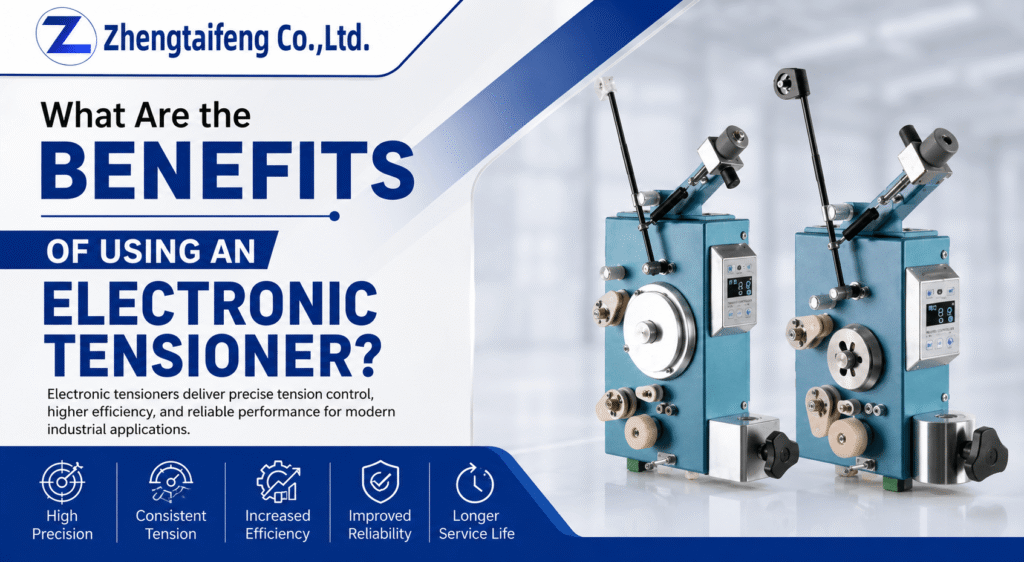
Modern manufacturing processes depend on accurate control, consistent quality, and reliable machine performance. In industries that process wire, cable, film, paper, textiles, foil, and other continuous materials, maintaining the correct tension is especially important. Even a small change in tension can affect winding quality, material alignment, production speed, and the final performance of a product.
This is where an electronic tensioner can make a significant difference. Unlike basic mechanical tension control methods, an electronic tensioner can use sensors, controllers, and electronically controlled actuators to monitor and adjust tension according to changing operating conditions. This allows manufacturers to achieve more consistent tension while improving process stability and reducing material-related problems.
Electronic tension control is particularly useful when production lines operate at higher speeds or handle materials with different thicknesses, strengths, and characteristics. Modern tension control systems can continuously measure actual tension, compare it with a target value, and adjust the braking or drive system to maintain the required level. This closed-loop approach is widely used in web-processing applications where stable tension is essential for production quality.
So, what are the benefits of using an electronic tensioner? The main advantages include improved tension accuracy, better winding quality, higher production consistency, reduced material waste, greater automation, and improved control over demanding manufacturing processes.
What Is an Electronic Tensioner?
An electronic tensioner is a tension control device or system designed to regulate the pulling force applied to a continuously moving material. Depending on the application, the material may be wire, cable, film, paper, textile, foil, tape, or another flexible or continuous product.
The basic purpose is simple: keep material tension within the desired range as the material moves through a machine.
A modern electronic tension control system can contain several components, including:
- Tension sensors or load cells
- Electronic controllers
- Measuring amplifiers
- Motors or drives
- Brakes
- Dancer systems
- User interfaces
- Machine control communication interfaces
In a closed-loop system, the sensor measures the actual tension. The controller compares this measurement with the required target tension and sends a correction signal to the actuator. The actuator then adjusts braking torque or drive speed to bring the tension closer to the desired value. This continuous feedback process is a fundamental principle of modern web tension control.
For manufacturers, this means tension does not have to depend entirely on manual adjustments or fixed mechanical settings.
How Does an Electronic Tensioner Work?
Understanding how an electronic tensioner works helps explain why it offers advantages over simpler tension control methods.
1. The material moves through the machine
The process begins as the material travels from an unwinding roll, through one or more processing stages, and potentially onto a rewinding roll. During this movement, the material needs to maintain an appropriate level of tension.
2. The tension is measured
A sensor or load cell detects the force acting on the material. Modern tension measurement systems can use load cells positioned around a measuring roller to detect the actual web tension.
3. The controller evaluates the measurement
The electronic controller receives the sensor signal and compares the actual tension with the target value.
For example, if the desired tension is 50 units and the measured tension falls below that level, the controller can determine that corrective action is necessary.
4. The actuator makes an adjustment
Depending on the machine design, the correction can involve adjusting brake torque, drive speed, or another control parameter. Electronic tension controllers can support different control structures, including closed-loop systems using load cells or dancer position.
5. The process continuously repeats
The system keeps measuring and correcting tension as production continues.
This is one of the biggest differences between electronic and purely mechanical tension control. Instead of relying only on a predetermined setting, an electronic system can respond to changes occurring during operation.
What Are the Main Benefits of Using an Electronic Tensioner?
1. More Accurate Tension Control
One of the most important benefits of an electronic tensioner is improved tension accuracy.
Manufacturing materials often require a specific tension range. If tension becomes too high, the material may stretch, deform, crease, or break. If tension becomes too low, the material may become loose, misaligned, or poorly wound.
Electronic tension systems use measurement and feedback to maintain the desired tension more consistently. Load cells can continuously detect actual tension, while the controller determines whether an adjustment is necessary.
This level of control is particularly valuable when working with sensitive materials or processes where small tension variations can affect quality.
2. Improved Winding Quality
Consistent tension is essential for producing properly wound rolls.
If tension is too low during winding, materials can become loose or uneven. In some web-processing applications, insufficient rewinding tension can contribute to problems such as roll telescoping. Excessive tension can also damage inner layers or distort the material.
An electronic tensioner helps maintain a controlled winding force, supporting:
- Uniform roll formation
- Better layer-to-layer consistency
- Reduced slack
- Improved edge alignment
- More predictable winding density
For wire and cable production, controlled tension can similarly contribute to stable winding and more consistent product handling.
3. Better Production Consistency
Production consistency is difficult to achieve when tension changes frequently.
Material diameter can change, roll diameter can increase during winding, machine speed can vary, and material properties can differ between production batches. A fixed mechanical setting may not respond effectively to every change.
Electronic tension control allows the system to adjust according to measured operating conditions.
This can make production more repeatable and help manufacturers maintain similar process conditions across longer production runs.
4. Reduced Material Waste
Material waste can be expensive, particularly when production involves high-value film, specialty paper, textiles, wire, cable, or other processed materials.
Incorrect tension can contribute to:
- Material breaks
- Wrinkles
- Creases
- Stretching
- Poor winding
- Misalignment
- Defective finished rolls
When tension is continuously monitored and controlled, the likelihood of tension-related process problems can be reduced. Reliable tension control is specifically intended to reduce web tears and production costs in web-processing applications.
Reducing waste can therefore improve both material efficiency and overall production economics.
5. Better Performance at Higher Machine Speeds
As manufacturing equipment becomes faster, maintaining stable process conditions becomes increasingly important.
At higher speeds, there may be less time for an operator or conventional mechanical system to respond to sudden changes. Electronic systems can monitor tension continuously and provide automatic corrections.
This makes electronic tensioners particularly useful in automated production environments where speed and precision must work together.
Modern tension control systems are designed around the need for faster production while maintaining precision, product quality, and reduced downtime.
6. Improved Automation
Another major benefit is automation.
Traditional tension adjustment may require operators to manually change brake settings, roller positions, or other machine parameters. An electronic tensioner can automate much of this process.
Once the desired tension is configured, the control system can continuously monitor the actual value and make adjustments automatically.
This can help operators focus on broader production tasks rather than repeatedly correcting tension manually.
Digital controllers can also provide user interfaces, programmable settings, alarms, and communication options for integration with machine control systems. Modern systems may support Ethernet or other industrial communication methods depending on the controller.
7. Easier Adjustment for Different Materials
Manufacturers often process more than one material on the same or similar equipment.
Different materials can have different tension requirements. A delicate film, for example, may require different treatment from a stronger industrial material.
An electronic tensioner can make changing between production settings easier when the system supports configurable parameters or recipes.
Some modern controllers offer recipe management, allowing different tension settings to be stored for different production requirements.
This can simplify changeovers and reduce the need for repeated manual setup.
8. Better Protection for Sensitive Materials
Not every production material can tolerate high mechanical force.
Thin films, textiles, coated materials, fine wires, and other sensitive products may be damaged if tension is excessive.
At the same time, tension cannot simply be reduced too much because insufficient tension can create its own production problems.
Electronic tension control allows manufacturers to target an appropriate tension value rather than relying on a broad mechanical adjustment.
The result can be gentler material handling and greater process stability.
9. Faster Response to Changing Conditions
Production conditions are rarely completely static.
For example, the diameter of a winding roll changes continuously. Machine speed may increase or decrease. Material characteristics can vary. The transition between rolls can also introduce temporary tension changes.
A feedback-based electronic system can respond to measured changes instead of relying only on fixed settings.
Some modern tension measurement systems use load cells because they can provide dynamic tension measurement without the same mechanical inertia associated with a dancer roller. This can support responsive control in processes such as cutting and winding.
10. Better Process Monitoring
An electronic tensioner can provide more than automatic adjustment. Depending on the system, it can also provide useful process information.
Operators may be able to monitor:
- Actual tension
- Target tension
- Tension deviations
- Machine status
- Alarm conditions
- Production settings
- Control parameters
This information can help operators identify problems before they result in significant material loss or production interruptions.
When electronic tension control is connected to broader machine automation, tension information can also become part of the overall production monitoring system.
Electronic Tensioner vs. Mechanical Tension Control
Mechanical tension control still has applications where simplicity, cost, and operating requirements make it appropriate. However, electronic tension control offers additional capabilities when greater precision and automation are required.
| Feature | Electronic Tensioner | Basic Mechanical Control |
| Automatic adjustment | Yes, depending on system | Usually limited |
| Continuous measurement | Yes | Often limited |
| Feedback control | Available | Usually not |
| Recipe-based settings | Possible | Usually unavailable |
| Integration with automation | Strong | Limited |
| Response to changing conditions | Dynamic | More dependent on mechanical setup |
| Process monitoring | Available | Limited |
| Complex production lines | Well suited | May require additional mechanisms |
The right solution depends on machine design, material characteristics, required accuracy, operating speed, and production goals.
Where Are Electronic Tensioners Used?
Electronic tension control can be useful across many continuous-material manufacturing processes.
Wire and Cable Manufacturing
Wire and cable production requires controlled material handling throughout drawing, winding, rewinding, and related processes. Stable tension can help prevent excessive force and support consistent winding.
Film Processing
Plastic films can be sensitive to stretching, wrinkles, and uneven tension. Electronic control can help maintain stable material movement during converting, coating, slitting, and winding.
Textile Manufacturing
Textile materials can respond differently to tension depending on their structure and composition. Controlled tension can support more consistent processing and reduce unwanted deformation.
Paper Processing
Paper can crease, tear, or become difficult to handle when tension is poorly controlled. Electronic systems can help maintain appropriate tension during converting and winding operations.
Printing and Converting
Printing and converting equipment often processes continuous webs at significant speeds. Stable tension is important for accurate material transport and consistent results.
Battery Material Processing
Advanced manufacturing applications can involve sensitive web materials that require carefully controlled handling. Modern tension measurement systems are available in configurations designed for specialized industrial environments, including battery-related applications.
What Should You Consider When Choosing an Electronic Tensioner?
Selecting the correct electronic tensioner is not simply about choosing the highest-rated device. The system should match the actual requirements of the machine and material.
Material Type
Start by identifying what the machine processes. Wire, cable, film, paper, textile, and foil can all have different tension requirements.
Required Tension Range
Determine the minimum and maximum tension needed for the application. The selected sensor and controller should be suitable for this operating range.
Machine Speed
Higher-speed applications may require a system capable of responding quickly to tension changes.
Control Method
Consider whether the machine requires:
- Open-loop control
- Closed-loop tension control
- Load-cell feedback
- Dancer-based control
- Brake control
- Drive-speed control
Different applications require different control structures. Modern digital controllers can support multiple approaches depending on machine configuration.
Environmental Conditions
Temperature, humidity, dust, moisture, chemicals, and other environmental factors can influence component selection.
For demanding environments, manufacturers may need suitable sensor materials, protection ratings, and installation configurations.
Machine Integration
If the tensioner needs to communicate with a PLC or broader automation system, check available communication interfaces and signal types.
Modern tension controllers can offer analog interfaces and industrial networking options, making integration easier in automated production environments.
How Can an Electronic Tensioner Improve Overall Production Efficiency?
The benefits of an electronic tensioner are not limited to tension measurement itself. Its biggest value comes from how tension control affects the entire production process.
When material tension remains stable, machines can operate more predictably. Operators may spend less time making manual adjustments, while the production line can experience fewer tension-related interruptions.
Consistent tension can also support better finished-product quality. For example, a properly controlled winding process can produce more uniform rolls, while stable web handling can reduce issues such as wrinkles, tears, and deformation.
Over time, these improvements can contribute to:
- Lower material waste
- Fewer production interruptions
- More consistent product quality
- Reduced manual intervention
- Easier machine setup
- Improved production repeatability
- Better utilization of manufacturing equipment
For manufacturers looking to modernize production equipment, electronic tension control can therefore be an important part of a broader automation strategy.
Why Is Electronic Tension Control Important for Modern Manufacturing?
Manufacturing is increasingly moving toward automated, data-driven, and highly controlled production processes.
Customers expect consistent quality, while manufacturers need to control material costs and improve productivity. These requirements make accurate process control more important than ever.
Tension is one of those process variables that can appear simple but have a major effect on production performance.
If tension is uncontrolled, small variations can become larger quality problems. If tension is measured and adjusted continuously, the machine can respond more effectively to changing conditions.
This is why modern web tension systems often combine sensors, controllers, actuators, displays, and communication interfaces into an integrated control loop.
For companies involved in wire, cable, winding, textile, film, paper, or other continuous-material processing, choosing an appropriate electronic tension solution can be an important step toward more stable production.
Why Choose Zhengtaifeng Co., Ltd. for Tension Control Solutions?
For manufacturers looking for industrial solutions related to winding, wire, cable, and tension management, Zhengtaifeng Co., Ltd. provides specialized manufacturing expertise in this field.
Choosing an electronic tensioner requires more than looking at a product specification. The solution should match the machine configuration, material properties, required tension range, production speed, and control requirements.
Zhengtaifeng Co., Ltd. focuses on industrial equipment and related solutions designed for demanding manufacturing applications. Businesses interested in learning more about available products and solutions can visit the official Zhengtaifeng Co., Ltd. website at https://www.zhengtaifeng.com/.
When evaluating a tensioner for a new machine or an existing production line, manufacturers should discuss their application requirements with the supplier. This can help ensure that the selected tension control solution is properly matched to the operating conditions.
Frequently Asked Questions About Electronic Tensioners
1. What is an electronic tensioner?
An electronic tensioner is a device or control system used to regulate the tension of a continuously moving material. It typically uses sensors, electronic controls, and an actuator such as a brake or drive to maintain the desired tension.
2. What is the main benefit of an electronic tensioner?
The main benefit is more consistent and controllable material tension. Depending on the system, electronic feedback can continuously measure actual tension and automatically adjust the machine when the measured value differs from the target.
3. Can an electronic tensioner reduce material waste?
Yes. Poor tension can contribute to material breaks, wrinkles, deformation, and winding defects. By maintaining more consistent tension, an electronic control system can help reduce tension-related production waste.
4. Are electronic tensioners suitable for high-speed machines?
They can be particularly useful for high-speed applications because electronic feedback systems can continuously monitor operating conditions and make automatic corrections. The exact suitability depends on the sensor, controller, actuator, machine speed, and application requirements.
5. What materials can be controlled with an electronic tensioner?
Electronic tension control can be used with many continuous materials, including wire, cable, film, paper, foil, textiles, and other web-type materials. The correct tension range and equipment configuration depend on the specific material.
6. What is closed-loop tension control?
Closed-loop tension control measures actual tension and compares it with a predefined target. The controller then sends a correction signal to an actuator, such as a brake or drive, to bring the tension toward the required value.
7. Is an electronic tensioner better than a mechanical tensioner?
The answer depends on the application. Mechanical systems can be appropriate for simpler processes, while electronic tensioners offer advantages when automatic adjustment, continuous measurement, higher precision, and integration with machine automation are important.
8. Can an electronic tensioner be integrated into an automated production line?
Yes. Many modern electronic tension control systems are designed for integration with machine controllers and industrial automation. Depending on the controller, communication can be supported through analog signals or industrial networking interfaces.
9. How do I choose the right electronic tensioner?
Consider the material type, required tension range, machine speed, roll diameter, control method, environmental conditions, actuator type, sensor requirements, and machine communication needs. Working with an experienced supplier can help identify a suitable configuration.
Conclusion
An electronic tensioner can provide significant advantages for manufacturing processes where stable and accurate material tension is essential. By combining tension measurement, electronic control, and automatic adjustment, it can help manufacturers achieve more consistent production conditions.
The major benefits include better tension accuracy, improved winding quality, reduced material waste, greater automation, faster response to process changes, improved material protection, and easier integration with modern manufacturing systems.
For applications involving wire, cable, film, paper, textiles, and other continuously moving materials, the right tension control solution can contribute to better productivity and more predictable product quality.
As manufacturing equipment becomes faster and more automated, electronic tension control is becoming an increasingly valuable technology for maintaining stable production. Manufacturers interested in exploring suitable solutions can learn more about Zhengtaifeng Co., Ltd. and its industrial product offerings through https://www.zhengtaifeng.com/.
Looking for reliable tension control solutions for your manufacturing process? Explore Zhengtaifeng Co., Ltd. to discover solutions designed for precise and consistent industrial material handling.