

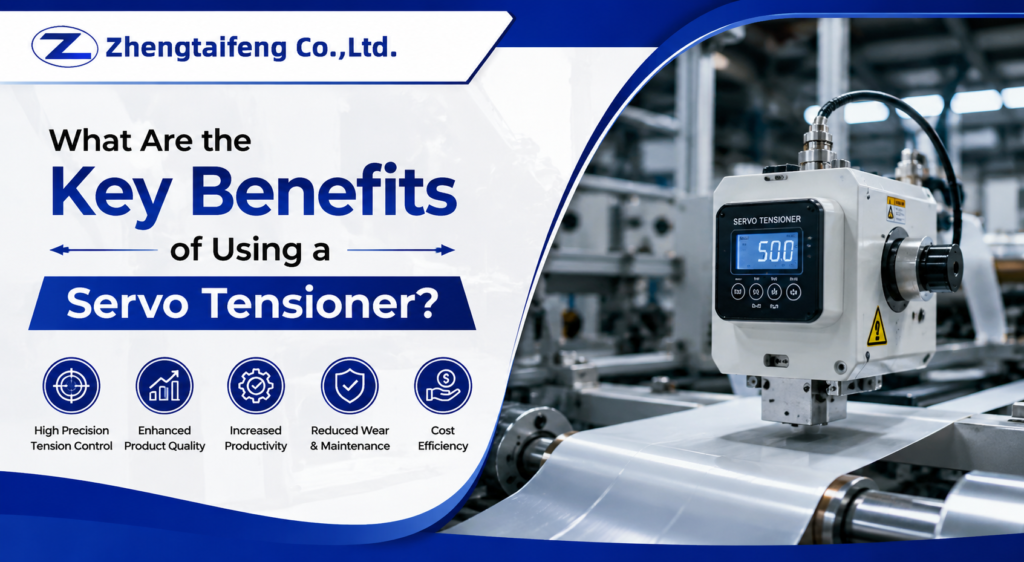
In modern manufacturing, maintaining consistent tension is essential for producing high quality wire, cable, film, fiber, textile, and other continuous materials. Even a small variation in tension can affect product quality, machine performance, winding accuracy, and production efficiency. This is where a servo tensioner can make a significant difference.
A servo tensioner uses a servo motor and a control system to regulate material tension with high precision. Compared with basic mechanical or passive tensioning methods, it can respond quickly to changes in speed, material conditions, and production requirements.
But what makes a servo tensioner valuable for industrial applications? The answer comes down to precision, responsiveness, automation, product quality, and better process control.
For manufacturers looking to improve tension management, understanding these benefits can help determine whether servo-based tension control is the right solution.
What Is a Servo Tensioner?
A servo tensioner is an electronically controlled tensioning device designed to maintain a specified level of tension as material moves through a production or winding process.
The system generally combines a servo motor, tension sensing or feedback components, a controller, and mechanical tensioning elements. The controller monitors the actual tension and adjusts the motor output when the tension moves away from the desired setpoint.
For example, if the tension becomes too high, the system can reduce the corrective force. If tension drops below the target, the servo system can respond by increasing the required force or torque.
This closed-loop approach allows manufacturers to maintain more stable tension than many traditional systems.
Servo tensioners are commonly used in applications involving:
- Wire and cable
- Optical fiber
- Film and foil
- Textile materials
- Tape and ribbon
- Electrical conductors
- Winding and rewinding processes
- Precision drawing and processing equipment
The exact configuration depends on the material, line speed, tension range, and machine design.
Why Is Tension Control Important in Manufacturing?
Before looking at the benefits of servo tensioners, it is useful to understand why tension control matters.
Continuous materials often need to travel through several stages during manufacturing. They may be unwound from a spool, processed, coated, drawn, inspected, or wound onto another reel. Throughout these stages, excessive or insufficient tension can create problems.
Too much tension can cause:
- Material stretching
- Deformation
- Breakage
- Surface damage
- Dimensional changes
- Excessive mechanical stress
Too little tension can result in:
- Loose winding
- Wrinkles
- Poor layer formation
- Material slipping
- Uneven winding
- Reduced process stability
A reliable tensioning system helps keep the material within the required operating range.
For manufacturers producing precision products, consistent tension is therefore not simply a machine setting. It can directly influence final product quality.
What Are the Key Benefits of Using a Servo Tensioner?
1. Precise Tension Control
One of the biggest advantages of a servo tensioner is its ability to provide precise control.
Servo systems can continuously adjust motor torque or speed according to feedback from the process. This enables the equipment to maintain a defined tension level even when operating conditions change.
Precision becomes particularly important when working with delicate materials such as optical fiber, fine wire, thin film, and specialty cable.
Instead of relying solely on a fixed mechanical force, a servo tensioner can actively respond to process conditions.
This can help manufacturers achieve more consistent production results and reduce variation between batches.
2. Faster Response to Tension Changes
Manufacturing conditions can change quickly. Line speed may increase, material diameter may vary, or the winding radius may change during operation.
A servo tensioner can respond dynamically to these changes.
The control system receives feedback and adjusts the servo motor accordingly. This rapid correction helps prevent tension fluctuations from becoming larger process problems.
For high-speed production lines, fast response is particularly valuable because there is less time available to correct tension deviations.
3. Improved Product Quality
Stable tension contributes directly to product consistency.
For example, in cable manufacturing, uncontrolled tension can influence conductor positioning, cable geometry, or winding quality. In optical fiber applications, excessive mechanical stress may affect the material during processing.
With accurate tension management, manufacturers can maintain more predictable operating conditions.
The result can be:
- More uniform products
- Better winding quality
- Fewer visible defects
- Improved dimensional consistency
- Lower risk of material damage
Servo tension control is therefore often considered part of a broader quality management strategy.
4. Better Winding and Rewinding Performance
Winding applications require careful control because the winding diameter changes continuously.
As material accumulates on a reel, the effective radius increases. If tension is not adjusted appropriately, the material can become too tight or too loose.
A servo-based system can account for these changing conditions and adjust its output.
This can support:
- More uniform layers
- Better reel formation
- Reduced material displacement
- Consistent winding density
- Improved handling of finished reels
For manufacturers that rely heavily on automated winding, accurate tension control can have a significant impact on overall production performance.
5. Greater Automation
Servo tensioners fit naturally into automated production environments.
Because the system can be controlled electronically, tension parameters can often be integrated with a machine’s PLC, motion controller, HMI, or other automation architecture, depending on the equipment design.
Operators can configure target values and monitor operating conditions from the machine interface.
This reduces the need for frequent manual adjustments and makes it easier to create repeatable production processes.
Automation can be especially useful when manufacturers produce multiple product specifications that require different tension settings.
6. Consistent Performance at Different Line Speeds
A production line may operate at different speeds depending on the material and product requirements.
Traditional tensioning methods can become less predictable when operating conditions change. A servo tensioner can compensate electronically for changes in speed and process demand.
This makes servo technology useful for applications that require both low-speed precision and high-speed operation.
The ability to maintain controlled tension across a wider operating range can also make production equipment more flexible.
7. Reduced Material Waste
Material damage and production defects can lead to significant waste.
If tension is too high, sensitive materials may stretch, deform, or break. If tension is too low, the material may not be processed or wound correctly.
By maintaining more consistent tension, servo tensioning can help reduce tension-related defects.
Less waste can mean:
- Lower material consumption
- Fewer rejected products
- Less machine downtime
- Better use of raw materials
- More predictable production costs
The actual savings depend on the material, machine configuration, and production volume, but even small reductions in waste can become meaningful in high-volume manufacturing.
8. Easier Parameter Adjustment
Modern manufacturing often requires machines to handle multiple materials or product sizes.
With a servo tensioner, operators can typically adjust tension electronically rather than physically modifying a mechanical tensioning mechanism.
This can make changeovers faster and more convenient.
For example, a manufacturer may need different tension values for different wire diameters. Instead of making repeated mechanical adjustments, the required settings can potentially be incorporated into machine recipes or production parameters.
This approach supports more flexible manufacturing.
9. Improved Process Repeatability
Repeatability is an important factor in industrial production.
If operators use different manual settings or mechanical adjustments from one production run to another, the resulting tension may vary.
A digitally controlled servo tensioner can help standardize the process.
Once suitable operating parameters have been established, manufacturers can use the same settings for similar production conditions. This can make processes easier to document, reproduce, and optimize.
For quality-focused manufacturers, repeatability can be just as important as peak performance.
How Does a Servo Tensioner Work?
Although designs vary between machines, the operating principle is relatively straightforward.
First, the material moves through the tensioning system. A tension sensor or another feedback mechanism detects the current tension.
The controller compares the measured value with the desired tension setpoint.
If there is a difference, the controller determines the required correction and sends a command to the servo drive.
The servo motor then adjusts torque, speed, or another controlled parameter to bring tension closer to the target.
The process can be summarized as:
Material movement → tension measurement → controller calculation → servo adjustment → tension correction
This feedback loop can operate continuously during production.
The effectiveness of the system depends on several factors, including sensor accuracy, controller tuning, servo motor characteristics, mechanical design, and the properties of the material being processed.
Servo Tensioner vs. Traditional Tensioning Methods
Traditional tensioning methods can still be suitable for many applications, especially where the process is relatively simple and precision requirements are modest.
However, servo tensioners offer active electronic control.
| Feature | Servo Tensioner | Traditional Mechanical System |
| Tension control | Active and programmable | Primarily mechanical |
| Response to changes | Fast and dynamic | Usually slower |
| Automation | High | Limited to moderate |
| Parameter adjustment | Electronic | Often manual |
| Process monitoring | Possible through control system | More limited |
| Repeatability | High when properly configured | Depends more on setup |
| Complex applications | Well suited | May require additional mechanisms |
The right choice depends on the application. A servo tensioner is not automatically necessary for every production line, but it becomes increasingly valuable as speed, precision, automation, and material sensitivity increase.
What Industries Use Servo Tensioners?
Servo tensioning technology can be applied across many industries.
Wire and Cable Manufacturing
Wire and cable production requires controlled movement and tension throughout various processing stages. Servo tensioners can help maintain stable conditions during winding, rewinding, drawing, and related operations.
Optical Fiber Production
Optical fiber is highly sensitive to mechanical stress. Accurate tension control can help manufacturers handle the material more consistently during processing and winding.
Textile Manufacturing
Threads, yarns, ribbons, and other textile materials can benefit from controlled tension, particularly in high-speed processes where variations can affect product appearance and quality.
Film and Flexible Materials
Thin films and similar materials can wrinkle or stretch when tension is not properly controlled. Servo tensioning can support more stable material handling.
Precision Winding
Applications involving coils, reels, spools, and precision winding often require consistent tension as the winding diameter changes.
What Should You Consider Before Choosing a Servo Tensioner?
Selecting a servo tensioner should be based on the actual production requirements rather than simply choosing the highest-performance model.
Important considerations include:
Required Tension Range
Determine the minimum and maximum tension required by the application. A system should provide suitable control throughout the complete operating range.
Material Characteristics
Consider the material’s diameter, strength, elasticity, surface properties, and sensitivity to mechanical stress.
Line Speed
Higher speeds generally require faster response and appropriate motor and control performance.
Feedback Accuracy
The quality of the tension sensor and feedback system can have a major effect on overall tension control.
Control Compatibility
Check whether the tensioner can integrate with the existing PLC, drive system, HMI, communication architecture, or other machine controls.
Mechanical Configuration
The roller arrangement, mounting method, motor capacity, and available machine space should all be evaluated.
Maintenance Requirements
Consider the accessibility of components, expected service requirements, spare parts availability, and long-term reliability.
Working with an experienced tension-control equipment manufacturer can make the selection process easier because the system can be matched to the actual production environment.
Can Servo Tensioners Improve Production Efficiency?
Yes, a properly selected and configured servo tensioner can contribute to production efficiency in several ways.
Better tension control can reduce material defects and interruptions. Electronic adjustment can simplify setup and changeovers. Automated feedback can also reduce the need for continuous manual intervention.
However, efficiency improvements depend on the entire production system.
A servo tensioner works best when it is correctly matched with:
- The material
- Production speed
- Sensor system
- Servo motor
- Controller
- Mechanical structure
- Winding equipment
- Machine control architecture
Correct commissioning and tuning are also important. Even a high-quality servo system may not deliver its full potential if the control parameters are poorly configured.
Why Choose an Experienced Servo Tensioner Manufacturer?
The tensioner itself is only one part of a complete tension-control solution.
Manufacturers should consider whether the supplier understands the application’s material, speed, tension requirements, control system, and mechanical environment.
An experienced supplier can help with product selection, customization, integration, and technical support.
Zhengtaifeng Co., Ltd provides industrial tension-control solutions designed for demanding manufacturing applications. Businesses interested in learning more about available equipment and tension-control technologies can visit the company’s official website at https://www.zhengtaifeng.com/.
When evaluating suppliers, look beyond the product specification sheet. Consider engineering support, customization capabilities, quality control, after-sales service, and experience with similar applications.
Frequently Asked Questions About Servo Tensioners
1. What is the main purpose of a servo tensioner?
The main purpose of a servo tensioner is to maintain controlled and consistent material tension during manufacturing, winding, rewinding, and other continuous-material processes.
2. Are servo tensioners suitable for high-speed production?
Yes. Servo tensioners are particularly useful for high-speed applications because electronic feedback and motor control can respond quickly to changes in tension and operating conditions.
3. Can a servo tensioner reduce material waste?
It can help reduce tension-related defects, material breakage, and inconsistent winding. The actual reduction in waste depends on the material, machine configuration, and production conditions.
4. What materials can be controlled using servo tensioners?
Servo tensioners can be used with various continuous materials, including wire, cable, optical fiber, textile yarn, film, tape, ribbon, and other materials requiring controlled tension.
5. How is a servo tensioner different from a mechanical tensioner?
A servo tensioner actively controls tension using electronic feedback and a servo motor. A mechanical tensioner generally relies on physical forces such as springs, friction, weights, or other mechanical mechanisms.
6. Does a servo tensioner require a tension sensor?
Many closed-loop servo tensioning systems use tension feedback from a sensor to achieve accurate automatic control. However, the exact configuration depends on the machine and control strategy.
7. Can servo tensioners be integrated into automated production lines?
Yes. Depending on the design, servo tensioners can integrate with PLCs, HMIs, motion controllers, servo drives, and other automation systems.
8. How do I choose the right servo tensioner?
Start by identifying the required tension range, material characteristics, line speed, winding diameter, feedback requirements, available space, and machine-control architecture. Supplier engineering support can then help identify a suitable configuration.
Conclusion
A servo tensioner can provide important advantages for manufacturers that need accurate, stable, and repeatable tension control. From better product quality and faster response to improved winding performance, automation, reduced waste, and easier parameter adjustment, servo technology can strengthen many continuous-material production processes.
The greatest value comes when the tensioner is properly matched to the material, line speed, control architecture, and production objectives. For companies seeking more reliable tension management, evaluating a servo tensioner can be an important step toward improving process consistency and manufacturing efficiency.
For industrial tension-control solutions and further product information, explore Zhengtaifeng Co., Ltd and visit the official Zhengtaifeng website.
Ready to improve tension control and production consistency? Explore servo tensioner solutions with Zhengtaifeng Co., Ltd today.